
HIGHLIGHTS
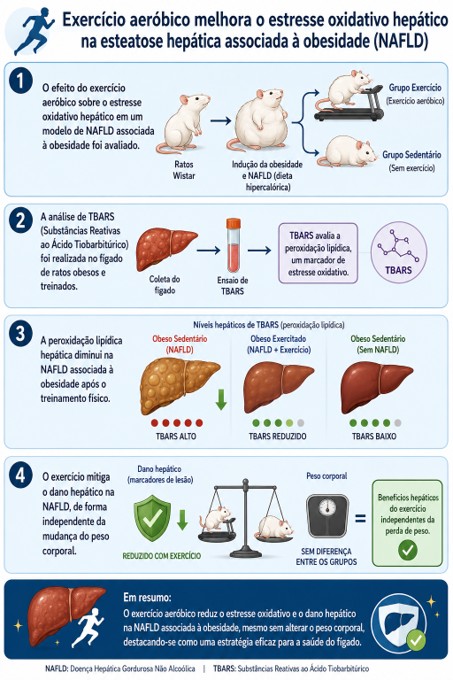
- Aerobic exercise effect on hepatic oxidative stress in a model of obesity-associated NAFLD was assessed.
- Hepatic TBARS analysis was conducted in obese-induced and exercise-trained rats.
- Hepatic lipid peroxidation decreases in obesity-associated NAFLD after exercise training.
- Exercise mitigates liver damage in NAFLD, independent of body weight change.
ABSTRACT
Background –
The global rise in obesity has been accompanied by an increasing prevalence of nonalcoholic fatty liver disease (NAFLD), for which effective non-pharmacological therapeutic strategies remain limited. Objective – This study investigated the effects of aerobic exercise on hepatic oxidative stress in an experimental model of obesityassociated NAFLD. Methods – Newly weaned Wistar rats were fed a highly palatable, obesity-inducing diet. After obesity was established, the animals were randomly assigned to either a trained group (n=12) or a sedentary group (n=12). The trained group underwent moderate-intensity treadmill running for eight weeks. Hepatic lipid peroxidation was assessed using the TBARS (thiobarbituric acid reactive substances) assay. Results – Aerobic training significantly reduced hepatic TBARS levels (P<0.0005), in an average of 1.8 nmol MDA/mg protein compared to the sedentary group. These benefits were significant regardless of weight gain maintenance. Conclusion – The findings suggest that regular physical exercise attenuates hepatic lipid peroxidation in an experimental model of obesity-associated NAFLD. The results support that physical exercise is an effective non-pharmacological strategy for modulating oxidative stress and preventing disease progression.
AUTORES
Wellgner Fernandes Oliveira AMADOR, Isabelle Castro VITOR, Milena Ramos TOMÉ, Diogo Delgado DOTTA and Rodrigo V MOTTA
