
HIGHLIGHTS
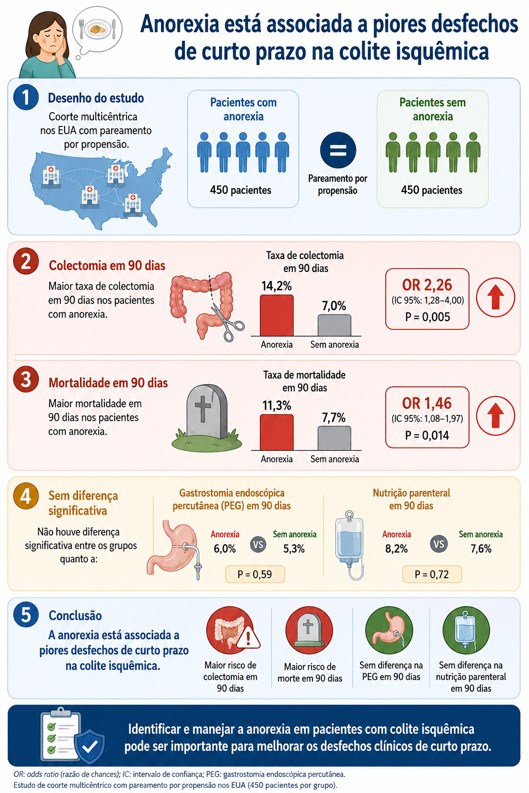
- Propensity-matched U.S. multicenter cohort (450 per group).
- Higher 90-day colectomy in anorexic patients (OR 2.26; P=0.005).
- Higher 90-day mortality in anorexic patients (OR 1.46; P=0.014).No significant difference in Percutaneous Endoscopic Gastrostomy or parenteral nutrition.
- Anorexia is linked to worse short-term ischemic colitis outcomes.
ABSTRACT
Background –
Ischemic colitis arises from a reduction in mesenteric blood flow, a condition often aggravated by factors such as severe dieting observed in individuals with anorexia nervosa which compromise the gastrointestinal vasculature, increasing the susceptibility to ischemic injury. Objective – This study aims to rigorously compare three-month clinical outcomes, including colectomy rates, mortality, and other complications, between anorexic and non-anorexic patients diagnosed with ischemic colitis. Methods – A validated multicenter database of more than 70 different healthcare systems across the United States was utilized. The population was divided into, Cohort 1 that consisted of anorexic patients with ischemic colitis and Cohort 2 which consisted of non-anorexic patients with ischemic colitis. After propensity score matching, a total of 450 patients were identified in each cohort. Outcomes were assessed over a 90-day period following the index event of ischemic colitis diagnosis. Kaplan-Meier curves and risk analyses were conducted to evaluate mortality, parenteral nutrition requirement, PEG placement and colectomy rates. Results – At three months, anorexic patients demonstrated significantly higher colectomy rates odds ratio (OR) of 2.262 (95%CI: 1.269– 4.031, P=0.005) and mortality with an OR of 1.462 (95%CI: 1.079–1.981, P=0.014) compared to their non-anorexic counterparts. The differences in PEG insertion and PN (parenteral nutrition) use were not statistically significant. Conclusion – Anorexic patients with ischemic colitis experience significantly worse short-term outcomes, including higher rates of mortality and colectomy, compared to their non-anorexic counterparts.
AUTORES
Chidera ONWUZO, FNU ALVINA, Rashid ABDEL-RAZEQ, Kofi AWUAH and Somtochukwu ONWUZO
