
HIGHLIGHTS
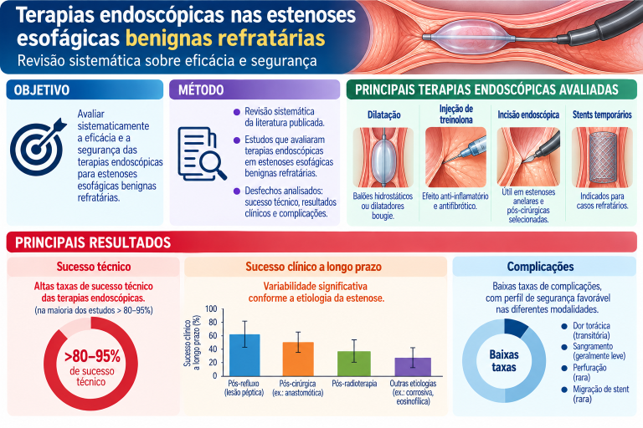
- To systematically evaluate the effectiveness and safety of endoscopic therapies for refractory benign esophageal strictures.
- A systematic review of published studies assessing technical success, clinical outcomes, and complications of endoscopic treatment modalities.
- Endoscopic therapies demonstrated high technical success rates; however, long-term clinical success varied significantly according to stricture etiology.
- Stricture etiology plays a central role in treatment durability, highlighting the need for standardized definitions and well-designed prospective studies.
ABSTRACT
Background –
Refractory benign esophageal strictures (RBES) represent a significant clinical challenge due to their diverse etiologies and the variety of available therapeutic approaches. They affect approximately 30–40% of patients with recurrent strictures. Objective – To evaluate the efficacy of endoscopic therapies stratified by stricture etiology (anastomotic vs nonanastomotic). Methods – We conducted a systematic review in accordance with the PRISMA guidelines, including studies published between 2005 and 2025. Literature searches were performed in PubMed, ScienceDirect, and the CAPES Portal. Outcomes assessed included technical success, complication rates, and long-term clinical success. Study screening and data extraction were performed independently by two reviewers using Rayyan software. Results – Eighteen studies were included, comprising 208 individuals with anastomotic strictures (72.2% of studies) and 265 with nonanastomotic strictures (77.8% of studies). Therapeutic modalities included bougie dilation (7 studies; 38.9%), balloon dilation (7; 38.9%), triamcinolone injection (2; 11.1%), mitomycin C (3; 16.7%), stricturotomy (6; 33.3%), stent placement (10; 55.6%), and self-dilation (1; 5.6%). The overall technical success rate was 84.1%, whereas clinical success was 58.1%. Anastomotic strictures were associated with a worse prognosis, exhibiting a technical success rate of 89.4%, a complication rate of 33.2%, and a clinical success rate of 53.8%. Nonanastomotic strictures showed a technical success rate of 80.0%, a complication rate of 11.3%, and a clinical success rate of 61.1%. Four definitions of refractoriness were identified; the most common was the failure to achieve a diameter of 14 mm to 15 mm or greater after multiple dilations (9 studies) and repeated dilations without quantified criteria (5 studies). Conclusion – RBES demonstrate high technical success rates across therapeutic modalities; however, long-term clinical success remains limited and varies according to etiology. Anastomotic strictures are associated with a worse prognosis than nonanastomotic strictures, likely reflecting the complexity of postsurgical fibrotic remodeling. The marked heterogeneity in definitions of refractoriness across studies represents a critical limitation in the current literature.
AUTOR
Aléxia Bezerra de Mendonça BELARMINO, José Jota MOURA NETO, Helena Aben-Athar PONTE, Franklin Freire Cartaxo ROLIM JÚNIOR, Diego Bomfim SABOIA and Marcellus Henrique Loiola Ponte de SOUZA
