
HIGHLIGHTS
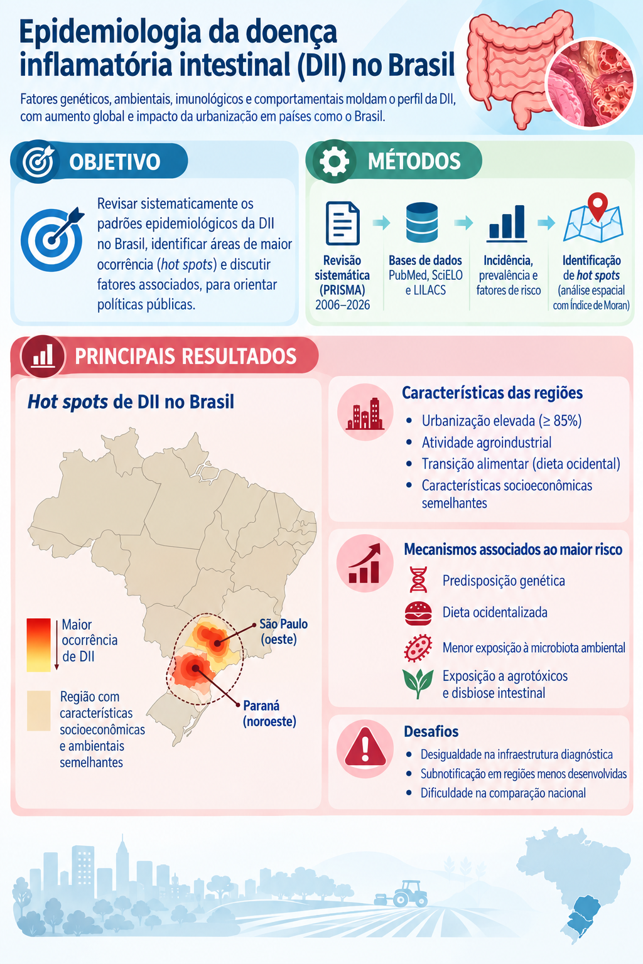
- The article analized the epidemiological patterns of Inflammatory Bowel Disease (IBD) in Brazil, highlighting “hot spots” in Western São Paulo and Northwestern Paraná, linked to high urbanization, westernized diets, and agro-industrial activities.
- Utilizing systematic review and spatial analysis, the study confirmed the geographic continuity of these areas as major zones of high disease prevalence.
- Multifactorial mechanisms, including environmental exposure, genetic predisposition, and unequal diagnostic infrastructure, were identified as significantly impacting IBD records and management.
- The study emphasizes the need for integrated public policies to address environmental factors, enhance nutritional education, and improve diagnostic access, particularly in underprivileged regions.
ABSTRACT
Background –
Inflammatory Bowel Disease (IBD) is a complex condition influenced by interactions among genetic, environmental, immunological, and behavioral factors. The global rise in IBD, particularly in rapidly urbanizing countries like Brazil, reflects environmental transitions’ impact on disease patterns. Regional disparities in diagnostic coverage and environmental factors highlight IBD “hot spots”, particularly in Western São Paulo and Northwestern Paraná, which share similar socio-economic and environmental characteristics. This study systematically reviews these epidemiological patterns to address gaps and support public health policies. Methods – A systematic literature review adhering to PRISMA guidelines was conducted to assess Brazilian IBD epidemiology from 2006 to 2026. Data sources included PubMed, SciELO, and LILACS, with Boolean search strategies incorporating controlled vocabulary and free-text terms. Eligible studies provided primary epidemiological data on IBD incidence, prevalence, and associated risk factors. Hot spots were identified through geospatial analysis using Moran’s I index, supported by integrative conceptual models like Directed Acyclic Graphs (DAGs). Results – The review identified prominent IBD hot spots in Western São Paulo and Northwestern Paraná, characterized by shared urbanization (85%+), agro-industrial activity, and dietary transitions. These regions exhibit increased prevalence due to multifactorial mechanisms, such as genetic predisposition, Westernized diets, reduced environmental microbial exposure, and pesticide-related dysbiosis. However, diagnostic infrastructure disparities highlight underreporting in less developed regions, complicating nationwide comparisons. Conclusion – Western São Paulo and Northwestern Paraná form a continuous IBD hot spot influenced by urbanization, agro-industrial practices, and environmental exposures. Addressing these challenges requires integrated public health policies focusing on environmental regulation, nutritional education, and improved diagnostic access. Future longitudinal studies should assess gene-environment interactions and further explore underrepresented regions to enhance IBD management and prevention strategies in Brazil.
AUTOR
Abel Botelho QUARESMA, Fabio V. TEIXEIRA, Douglas A. VALVERDE, Adriano A. F. HINO, Aderson OMC DAMIÃO, Paulo Gustavo KOTZE
