
HIGHLIGHTS
- SARS-CoV-2 infection did not worsen inflammatory bowel disease (IBD) outcomes.
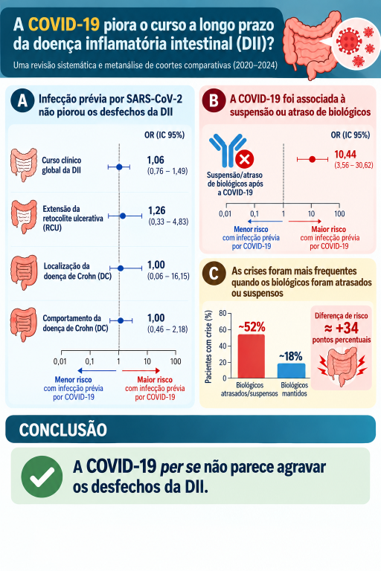
- Stopping or delaying biologics during COVID-19 was linked to much higher flare rates (≈52% vs 18%).
- Continuing biologics in patients without high-risk features for severe COVID-19 should be considered, given the higher flare rates observed after treatment discontinuation.
- Look beyond the virus, also keep IBD control in focus: anticipate flares and avoid reflexive treatment pauses in low-risk COVID cases.
ABSTRACT
Background/Objective –
Whether COVID-19 worsens the longterm course of inflammatory bowel disease (IBD) remains uncertain. We synthesized comparative cohorts to assess IBD outcomes after SARS-CoV-2 infection versus noninfected IBD controls and to evaluate the impact of biologic discontinuation. Methods – Systematic review (PRISMA 2020). Adult IBD cohorts with vs without prior SARS-CoV-2. Databases: MEDLINE (PubMed), Web of Science, and Scopus; reference lists screened. Time window: Jan 2020 to Dec 2024. Risk of bias: Newcastle–Ottawa. Randomeffects Mantel–Haenszel with REML variance and Hartung–Knapp adjustment; heterogeneity by I2 /τ2 /Q. Zero events handled via 0.5 continuity correction; sensitivity analyses reported risk differences (percentage points) and studylevel effects for sparse outcomes. Certainty graded with GRADE. Results – Four matched cohorts (n≈1.3k; Italy/USA). Prior SARS-CoV-2 did not worsen IBD clinical course (OR: 1.06; 95%CI: 0.76-1.49), nor alter UC extent (OR: 1.26; 95%CI: 0.33-4.83) or CD location/behavior (OR: 1.00; 95%CI: 0.06-16.15 / OR: 1.00; 95%CI: 0.46-2.18). Conversely, COVID-19 associated with biologic delay/discontinuation (OR: 10.44; 95%CI: 3.56-30.62). Across studies, flares were more frequent when biologics were delayed/stopped (~52% vs ~18%; RD ≈ +34 p.p.). Conclusion – COVID-19 per se does not appear to aggravate IBD outcomes; the clinically actionable signal is treatment continuity. In IBD patients without highrisk features for severe COVID-19, maintaining biologics should be considered to prevent flares.
AUTOR
Mariana ROLIM, Andrea Benevides LEITE, Lauro Vieira PERDIGÃO NETO and Anna Sara LEVIN
