
HIGHLIGHTS
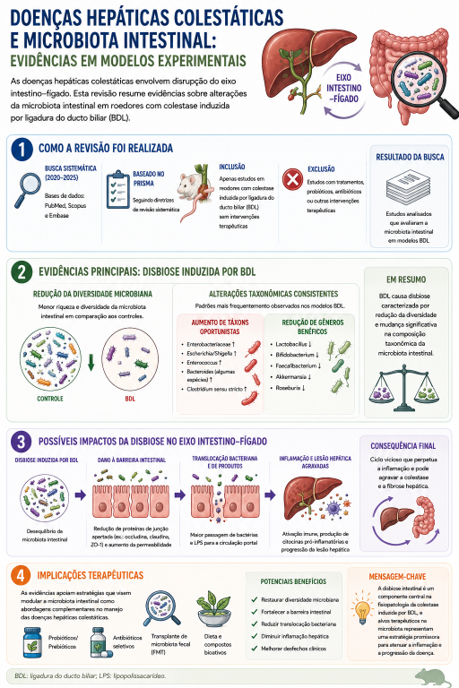
- Cholestatic liver diseases involve gut–liver axis disruption, and this review summarizes evidence on gut microbiota alterations in rodents with BDL-induced cholestasis.
- A PRISMA-based systematic search (2020–2025) of PubMed, Scopus, and Embase included only studies using BDL without therapeutic interventions.
- Evidence consistently shows BDL-induced dysbiosis, with reduced diversity and significant taxonomic shifts, including increased opportunistic taxa and reduced beneficial genera.
- These alterations may impair intestinal barrier integrity, enhance bacterial translocation, and exacerbate liver inflammation, supporting microbiota-targeted therapeutic approaches.
ABSTRACT
Background –
Cholestatic liver diseases are a major public health issue, marked by impaired bile flow and significant disruptions in liver and systemic physiology. Growing evidence points to the gut microbiota as a key player in cholestasis pathogenesis through gut liver axis interactions. This systematic review aimed to synthesize and evaluate current findings on intestinal microbiota changes in rodents (rats and mice) subjected to bile duct ligation (BDL)-induced cholestasis, focusing on microbial diversity, taxonomic shifts, and potential pathophysiological implications. Methods – A comprehensive literature search was conducted in PubMed, Scopus, and Embase for studies published from January 2020 to February 2025, following PRISMA guidelines. Eligible studies included original research using BDL in rodents without therapeutic intervention and reporting gut microbiota profiles. Data were qualitatively analyzed, emphasizing experimental conditions and microbiome outcomes. Results – Twenty-two studies met inclusion criteria. Most used 16S rRNA sequencing; two used shotgun metagenomics. BDL consistently induced gut dysbiosis, with reductions in alpha diversity (in most studies), altered beta diversity, and shifts in dominant phyla such as Firmicutes, Bacteroidetes, Proteobacteria, Actinobacteria, and Verrucomicrobiota. At finer taxonomic levels, increases in Prevotella, Enterococcus, Escherichia coli, and Alistipes were common, while Lactobacillus and Ruminococcus often decreased. Elevated levels of Akkermansia muciniphila and Bifidobacterium pseudolongum may represent compensatory microbial responses. Conclusion – Bile duct ligation (BDL)-induced cholestasis leads to complex changes in the microbiota that can worsen intestinal barrier integrity, increase bacterial translocation, and intensify liver inflammation. These findings reinforce the central role of the gut-liver axis and corroborate the potential of microbiota-targeted therapies in the management of cholestatic liver diseases. However, as most of the available evidence derives from experimental models, further well-designed clinical studies are needed to validate the safety, efficacy, and translational applicability of these strategies in human diseases.
AUTOR
Stephane Lima CALIXTO, Ana Caroline Lopes de Paula MACEDO and Jair Adriano Kopke AGUIAR
