
HIGHLIGHTS
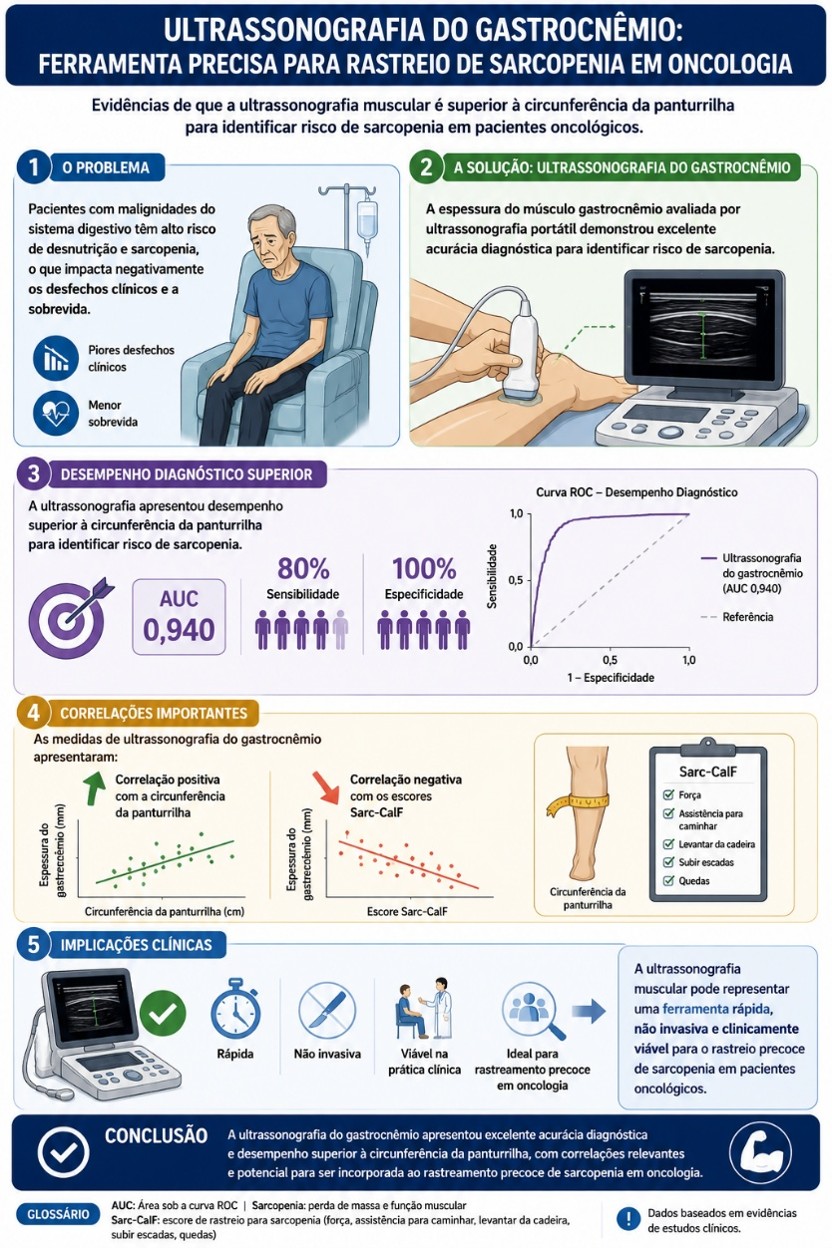
- Cancer patients with digestive system malignancies are at high risk of malnutrition and sarcopenia, which adversely impact clinical outcomes and survival.
- Gastrocnemius muscle thickness assessed by portable ultrasound demonstrated excellent diagnostic accuracy for identifying sarcopenia risk.
- Ultrasound showed superior performance (AUC 0.940; 80% sensitivity, 100% specificity) compared with calf circumference.
- Gastrocnemius ultrasound measurements correlated positively with calf circumference and negatively with Sarc-CalF scores.
- Muscle ultrasound may represent a rapid, noninvasive, and clinically feasible tool for early sarcopenia screening in oncology settings.
ABSTRACT
Background –
Cancer is a malignant disease characterized by the accumulation of genetic alterations with uncontrolled cell growth. In 2022, approximately 20 million new cancer cases and nearly 10 million deaths occurred globally. Cancer patients are at high risk for malnutrition due to the disease and treatment. Sarcopenia can negatively affect clinical outcomes and is associated with a higher likelihood of adverse results, including falls, fractures, low physical performance, and mortality. Objective – The aim of this study was to determine whether ultrasound of the gastrocnemius muscle can be a method for detecting the risk or presence of sarcopenia in patients with digestive system cancer. Methods – This is a cross-sectional study conducted with patients diagnosed with digestive system cancer, aged 18 years or older, undergoing treatment. The 2018 EWGSOP algorithm was used to evaluate sarcopenia, and participants were classified into two groups: one group at risk for sarcopenia or sarcopenic and another group as non-sarcopenic. A portable ultrasound (BodyMetrix™ BX2000 ultrasound) was used to measure the thickness of the gastrocnemius muscle. Results – The diagnostic performance of ultrasound (US) and calf circumference (CC) in detecting sarcopenia was evaluated by the area under the ROC curve. The area under the curve for US was 0.940, with 80% sensitivity and 100% specificity, and for CC, it was 0.889, with 72% sensitivity and 95% specificity. We found a negative correlation between the measure of the gastrocnemius muscle by ultrasound (US) and Sarc-CalF, and a positive correlation between the US and calf circumference (CC). Conclusion – The evaluated method shows potential for clinical application, suggesting it could be a fast and sensitive clinical tool. However, further studies are needed to establish robust evidence base and achieve a more accurate sarcopenia diagnosis for early multidisciplinary intervention.
AUTORES
Tassiane de Paula SUDBRACK, Katia BARÃO and Nora Manoukian FORONES
