
HIGHLIGHTS
- To evaluate whether colonoscopy with water infusion improves technical indicators and patient comfort when compared to air/CO2 insufflation.
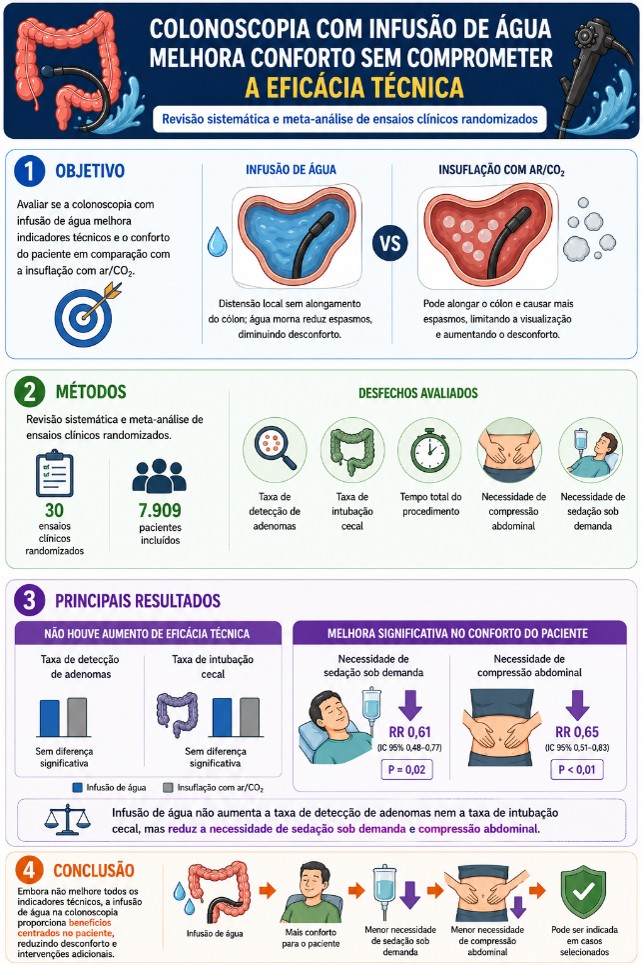
- Systematic review and meta-analysis of 30 randomized controlled trials (7,909 patients) comparing adenoma detection rate, cecal intubation rate, procedure time, abdominal compression, and on-demand sedation.
- Water infusion did not increase adenoma detection rate or cecal intubation rate, but reduced on-demand sedation (RR 0.61) and abdominal compression (RR 0.65), improving comfort.
- Although it does not improve all technical indicators, water infusion brings patient-centered benefits and can be indicated in selected cases.
ABSTRACT
Background –
Colonoscopy is a widely used screening method for colorectal cancer, playing a crucial role in early detection and prevention by allowing visualization and removal of precancerous lesions. It also helps diagnose and manage neoplastic lesions and inflammatory bowel disease by providing direct visualization of the intestinal mucosa. However, traditional air or carbon dioxide (CO2 ) insufflation may limit complete visualization of the colon. Alternatively, water infusion causes local distension without elongating the colon (unlike air insufflation), while warm water reduces spasms, decreasing insertion time and patient discomfort. Objective – This systematic review and meta-analysis aimed to compare water infusion versus air/CO2 insufflation in terms of technical efficacy, evaluate the effect of water immersion on procedural difficulty, and determine the accuracy of water immersion colonoscopy in detecting colon adenomas. Methods – We searched MEDLINE, EMBASE, and Cochrane CENTRAL databases for randomized controlled trials published from inception to January 2023. Outcomes included adenoma detection rate, success rate of cecal intubation, cecal intubation time, total procedure time (from insertion to withdrawal), need for abdominal compression, and on-demand sedation rate. Thirty randomized controlled trials were included. Results – Adenoma detection rate, success rate of cecal intubation, cecal intubation time, and total procedure time showed no significant difference between the two methods (P>0.05). However, water infusion significantly reduced the proportion of participants requiring on-demand sedation (risk ratio 0.61, 95%CI 0.48-0.77, P=0.02) and abdominal compression (risk ratio 0.65, 95%CI 0.51–0.83, P<0.01). Conclusion – Colonoscopy with water infusion helps the colonoscope reach the cecum more easily, decreasing the need for on-demand sedation and abdominal compression.
AUTORES
Fernando RODRIGUEZ-GUZMAN, Anna Carolina Orsini ARMAN, Marcelo Morganti Ferreira DIAS, Diego PATERNOSTRO, Bruna Haueisen FIGUEIREDO-ZWETKOFF, Otávio MICELLI-NETO and José Celso ARDENGH
