
HIGHLIGHTS
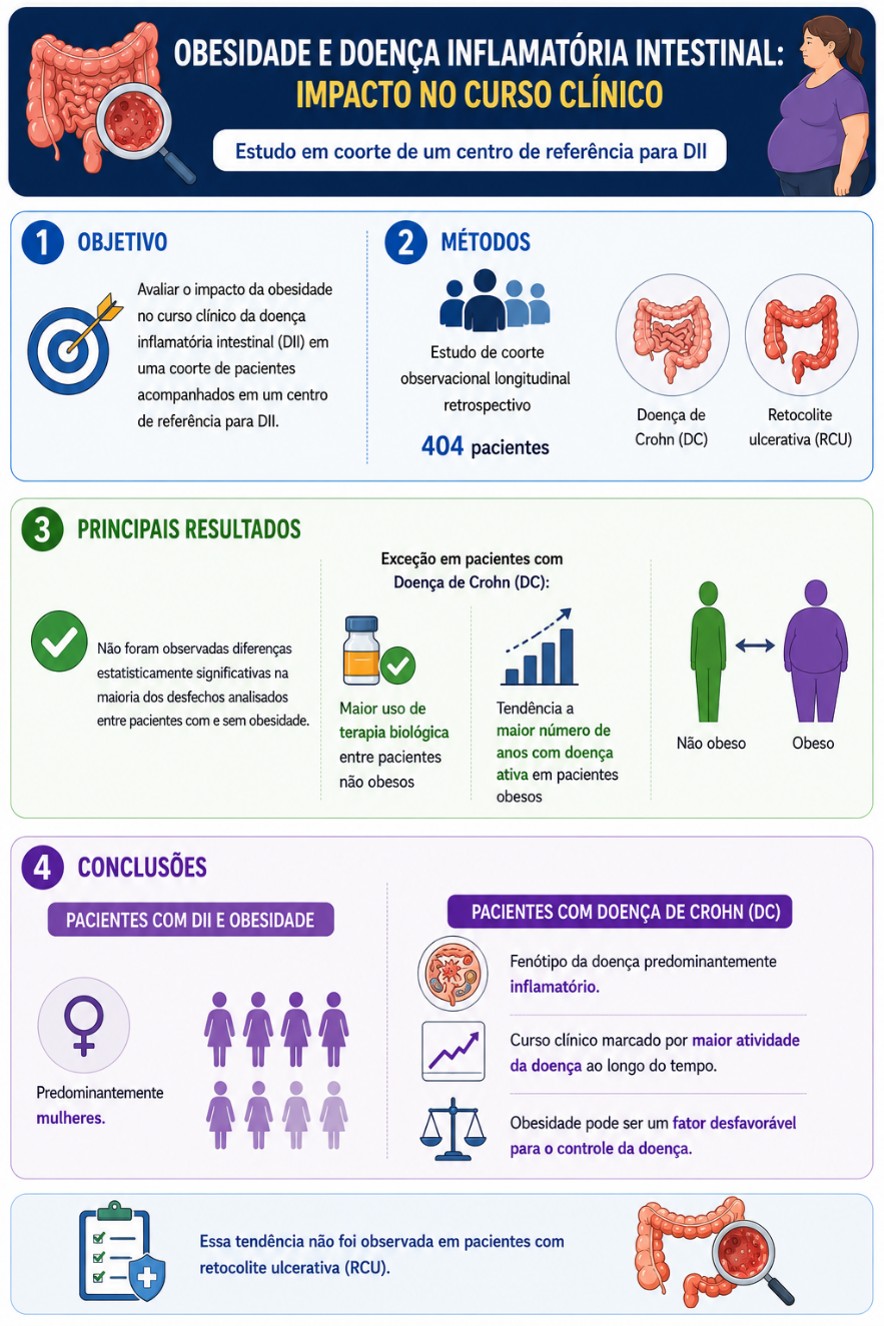
- To evaluate the impact of obesity on the clinical course of inflammatory bowel disease (IBD) in a cohort of patients followed at an IBD referral center.
- Retrospective longitudinal observational cohort study including 404 patients diagnosed with IBD, classified as having either Crohn’s disease (CD) or ulcerative colitis (UC).
- No statistically significant differences were observed in most of the outcomes analyzed, except for a higher frequency of biologic therapy use among non-obese patients with CD. There was also a trend toward a greater number of years with active disease in obese patients with CD.
- IBD patients with obesity were predominantly female. Among those with CD, the disease phenotype was primarily inflammatory, with a clinical course marked by greater disease activity over time, suggesting that obesity may be an unfavorable factor for disease control. This trend was not observed in patients with UC.
ABSTRACT
Background –
The incidence and prevalence of disorders such as obesity, metabolic syndrome (MS), and inflammatory bowel disease (IBD) have increased over recent decades. MS is a complex condition represented by a cluster of cardiovascular risk factors with a multifactorial origin—including genetic, behavioral, dietary factors, and alterations in gut microbiota. IBD reflects a complex and heterogeneous immunemediated condition that typically, though not exclusively, affects the intestine. Objective – To evaluate the impact of obesity on the clinical course of IBD in a cohort of patients followed at a referral center for IBD. Methods – This was a retrospective longitudinal observational cohort study including patients of both sexes and all ethnicities, followed at the Inflammatory Bowel Disease Referral Center of the University Hospital of the Federal University of Juiz de Fora, between January 2019 and August 2023. A total of 404 adults aged 18 to 80 years with a diagnosis of IBD–established by clinical, endoscopic/histological, and/or imaging criteria–were included. IBD cases were classified as either Crohn’s disease (CD) or ulcerative colitis (UC). To assess DII annual activity, electronic medical records were reviewed for outpatient visits and hospitalizations from 2019 to 2023. CD was considered active when the Harvey-Bradshaw Index (HBI) was ≥5, and UC was considered active when the total Mayo score was ≥3 or the partial Mayo score was ≥2. Results – The mean age at IBD diagnosis was 37.79±13.44 years, with an average disease duration of 12.50±8.3 years. Biologic therapy was used in the majority of patients (58.4%), with treatment failure occurring in 56.8% of these cases during the study period. No statistically significant differences were observed in most outcomes, except for a higher frequency of biologic use in nonobese patients with CD (P=0.028). There was a trend toward a greater number of years with active disease in obese patients with CD (P=0.062). Conclusion – IBD patients with obesity were predominantly female. Among those with CD, the phenotype was mainly non-stricturing, nonpenetrating, with a clinical course characterized by greater disease activity over time, suggesting that obesity may be an unfavorable factor for disease control. This trend was not observed among patients with UC.
AUTORES
Roberta Oliveira Raimundo BORSATO, Júlio Maria Fonseca CHEBLI, Tarsila Campanha da Rocha RIBEIRO, Luiz Henrique Silva BORSATO, Marcos Paulo Moraes SALES, Maria Antônia de Lima BARRA
