
HIGHLIGHTS
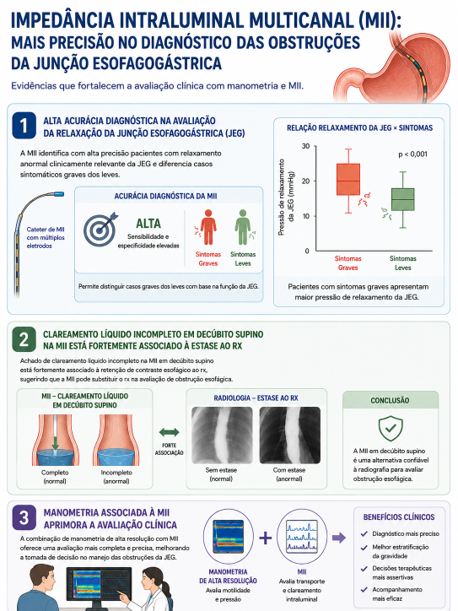
- Multichannel intraluminal impedance (MII) demonstrates high diagnostic accuracy for identifying patients with clinically relevant abnormal esophagogastric junction relaxation and can distinguish between severe and mild symptomatic cases.
- MII findings of incomplete liquid clearance in supine position strongly associated with radiologic evidence of esophageal contrast stasis, suggesting MII can serve as a reliable alternative to radiography in evaluating esophageal obstruction.
- The use of manometry with MII improves the clinical evaluation of patients with suspected esophagogastric junction outflow obstruction.
ABSTRACT
Background –
A clinically relevant conclusive diagnosis of esophagogastric junction outflow obstruction (EGJOO) requires a manometric diagnosis, relevant symptoms and adjunct exams supporting outflow obstruction. Multichannel intraluminal impedance measurement provides an evaluation of esophageal clearance. Objective – This study aimed to evaluate the effectiveness of multichannel intraluminal impedance in providing supportive evidence of outflow obstruction and differentiating between severe and mild cases in patients suspected of having esophagogastric junction outflow obstruction. Methods – A cohort of fifty-nine patients presenting with Abnormal Esophagogastric Junction Relaxation (AEJR), as classified by Chicago Classification version 4.0, was selected from a retrospective, single-center study. Their data from high-resolution impedance manometry were reviewed and compared with clinical and radiologic data. Patients were classified as highly symptomatic (AEJR-HS) or moderately/mildly symptomatic (AEJR-MS) using the Eckardt score. Results – AEJR-HS was identified in 28 patients and AEJR-MS in 24. Incomplete liquid clearance by multichannel intraluminal impedance demonstrated a strong association with radiological incomplete esophageal clearance (OR: 14.08, 95%CI 2.93 – 87.60, P<0.001) and high diagnostic accuracy (93.2%) for EGJOO CC v4.0. Forty percent or more incomplete liquid clearance by multichannel intraluminal impedance during supine swallows showed good accuracy in separating AEJR-HS from AEJR-MS with 75% sensitivity and 83% specificity (AUC=0.825; 95%CI 0.708-0.941, P<0.001). Conclusion – Multichannel intraluminal impedance closely matches esophageal radiography in identifying severe obstructive symptoms and incomplete clearance in AERJ patients and may serve as na alternative to radiography in confirming EGJOO v4.0 in patients with manometric EGJOO.
AUTOR
Felipe Nelson MENDONÇA and Ricardo Brandt de OLIVEIRA
