
HIGHLIGHTS
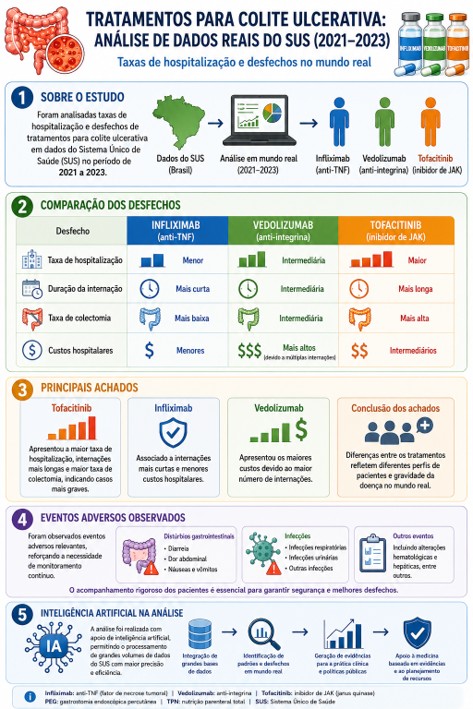
- Real-world hospitalization rates and outcomes of ulcerative colitis treatments (infliximab, vedolizumab, tofacitinib) were analyzed using Brazilian public health data (2021–2023).
- Tofacitinib showed the highest hospitalization rate, longer stays, and higher colectomy rates, indicating more severe cases.
- Infliximab was linked to shorter hospital stays and lower costs.
- Vedolizumab had the highest costs due to multiple admissions.
- Adverse events, such as gastrointestinal disorders and infections, were observed, emphasizing the need for careful monitoring.
- Artificial intelligence powered the analysis, showcasing its role in improving medical research, evidence-based medicine, and resource planning.
ABSTRACT
Background –
Objective – Ulcerative colitis (UC) is a chronic inflammatory bowel disease that requires advanced therapies, including infliximab, vedolizumab, and tofacitinib. Our aim is to understand the hospitalization rates and outcomes associated with these therapies in real-world scenarios, which is crucial for optimizing patient management and healthcare resource allocation. Methods – This nationwide retrospective observational study analyzed real-world data (RWD) from Brazil’s public healthcare system (SUS) between January 2021 and December 2023. Data on hospitalizations, length of stay, mortality, costs, and non-IBD-related hospital admissions were extracted and analyzed using the Techtrials TT Disease Explorer and TT RWE Generator, leveraging generative artificial intelligence (GenAI) for data integration and analysis. Results – A total of 1,313 patients required hospitalization, with 1,434 hospitalizations recorded. The hospitalization rate per 100 patients was highest for tofacitinib (262.5), followed by infliximab (212.88) and vedolizumab (191.67). Patients treated with infliximab had the shortest hospital stay (Median 3.0 days [0-68]) and lowest costs (Median 510.83 BRL [23.45 – 111,594.14]), whilst vedolizumab had the highest hospitalization costs. Surgical intervention rates were highest among tofacitinib users. Non-IBD-related hospitalizations suggested potential adverse drug events, including gastrointestinal disorders, infections, and anemia. Conclusion – This study represents the first AI-assisted RWE analysis of UC hospitalizations in Brazil. The findings highlight the varying hospitalization burdens across advanced therapies, with tofacitinib associated with higher hospitalization rates and infliximab linked to shorter hospital stays and lower costs. These insights can inform clinical decision-making and healthcare policy. Future studies should further explore AI’s role in optimizing RWE research and UC management.
AUTORES
Douglas Andreas VALVERDE, Abel Botelho QUARESMA, Maria Paz Gimenez VILLAMIL, Thyago Proença de MORAES and Paulo Gustavo KOTZE
