
HIGHLIGHTS
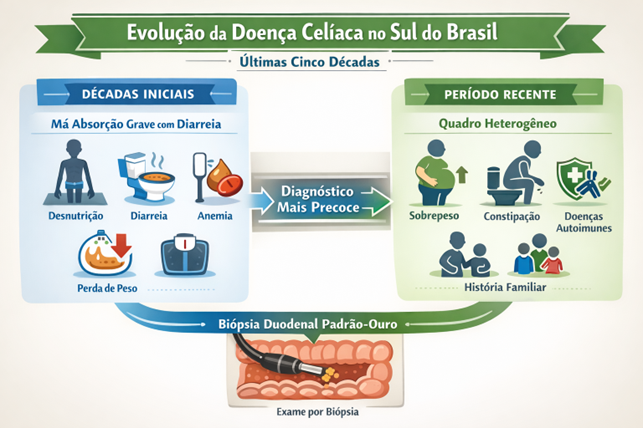
- Clinical presentation of celiac disease in Brazil shifted over five decades.
- Duodenal biopsy with Marsh classification remains the diagnostic gold standard.
- Diarrhea declined, while reflux and bloating became more common.
- Serological screening and awareness enabled earlier, less severe diagnoses
ABSTRACT
Background –
Since the mid-20th century, celiac disease (CD) has evolved from being regarded as a predominantly pediatric disorder to one increasingly recognized across all ages. In Brazil, CD was initially underdiagnosed, but diagnostic advances and greater awareness have led to a broader understanding of its epidemiology and clinical spectrum. Objective – To describe the evolving clinical, laboratory, and histological profile of Brazilian adults diagnosed with CD over the past five decades. Methods – A retrospective descriptive study was conducted including 181 adults with biopsy-confirmed CD managed at a referral private practice in in Curitiba, Brazil, from 1975 to 2025. Patients were stratified into three diagnostic phases: phase 1 (1975–2000), phase 2 (2001–2010), and phase 3 (2011–2025). Clinical manifestations, nutritional status, comorbidities, histological findings, and laboratory parameters were analyzed comparatively. Results – The cohort was predominantly female (84.8%), with a median age of 36 years at diagnosis. Marsh III lesions were observed in 98.0% of phase 1 cases, remaining the most frequent finding across phases. Underweight was prevalent in phase 1 (63.2%) but declined significantly in phase 2 (26.4%) and phase 3 (16.5%), reflecting, probably, earlier detection. Diarrhea predominated in phases 1 and 2, whereas constipation became more frequent in phase 3. Extraintestinal manifestations such as anemia, fatigue, and weight loss decreased over time, while reports of comorbid immune-mediated diseases and family history of gluten-related disorders increased. Conclusion – Over the last 50 years, the clinical presentation of CD in Southern Brazil has shifted from advanced malnourished states with diarrhea to more heterogeneous profiles including constipation and overweight. Despite advances in serology, duodenal biopsy remains the gold standard for diagnosis. These findings underscore the importance of continuous clinical vigilance and reflect a sustained contribution to CD management in Brazil.
AUTORES
Lorete Maria da Silva KOTZE, Shirley Ramos da Rosa UTIYAMA, Luiz Roberto KOTZE, Fabiana Antunes ANDRADE and Renato NISIHARA
