
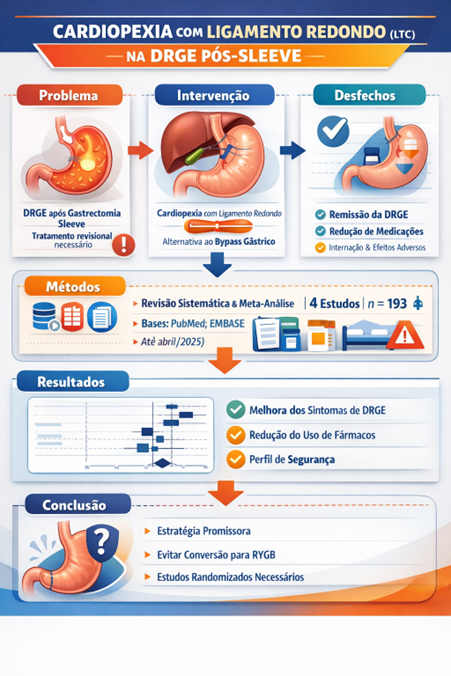
HIGHLIGHTS
- Ligamentum teres cardiopexy (LTC) may serve as a viable surgical option for patients with persistent GERD after sleeve gastrectomy, especially those who are not suitable candidates for conversion to Rouxen-Y gastric bypass.
- Current evidence does not support the routine use of LTC as a primary anti-reflux intervention during initial sleeve gastrectomy due to limited supporting data.
- Surgeons should avoid overtightening the valve during LTC to prevent postoperative dysphagia, and more robust, randomized studies are needed to better define LTC’s role in both primary and revisional bariatric surgery.
ABSTRACT
Background –
Gastroesophageal Reflux Disease (GERD) is the most common long-term complication after Sleeve Gastrectomy (SG). Ligamentum teres cardiopexy (LTC) has been proposed as a revisional alternative to treat GERD symptoms. Objective – To evaluate, through a systematic review and meta-analysis, the safety and effectiveness of LTC in the remission of GERD symptoms and in reducing the use of anti-reflux medications in patients who previously underwent SG. Methods – We conducted a systematic review and meta-analysis to evaluate LTC’s safety and its impact on GERD after SG. We systematically searched PubMed, EMBASE, and Cochrane Central for studies assessing LTC in patients who underwent SG up to april 2025. The primary outcomes included remission of GERD symptoms and prevalence of GERD medications after surgery. Secondary outcomes were length of stay and adverse effects. Observational studies were included. A random-effects model analysis for GERD remission and prevalence of GERD medications were performed. Study weights were calculated using the inverse variance method, with statistical analyses conducted in R version 4.4.0. Results – Four studies including 193 patients were analyzed. Overall, remission of GERD symptoms among patients undergoing revisional LTC alone, the remission rate was 75.50% (95%CI 59.55–86.57; I²=41.4%). Additionally, 33.42% of patients (95%CI 19.74–50.60; I²=44.7%) needed to use GERDrelated medication postoperatively. Conclusion – LTC shows potential as a surgical option for managing GERD after SG, particularly in revisional cases as an alternative to Roux-en-Y gastric bypass.
AUTORES
Pedro Bicudo BREGION, Victor Kenzo IVANO, Luca Maunsell PEREIRA, Isadora CHRISPIM, Everton CAZZO and Anna Carolina Batista DANTAS
