
HIGHLIGHTS
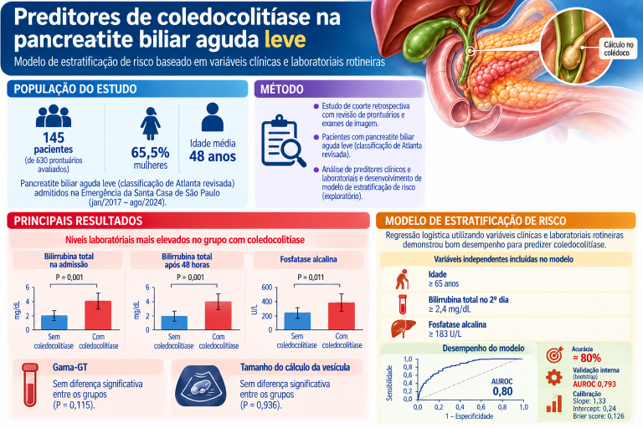
- Age ≥65 years, persistent bilirubin elevation, and elevated alkaline phosphatase were associated with choledocholithiasis.
- A simple clinical score demonstrated acceptable discrimination for risk stratification of choledocholithiasis.
- The model showed greater utility in identifying patients with a low probability of choledocholithiasis.
ABSTRACT
Background –
Acute biliary pancreatitis is one of the most common forms of acute pancreatitis and is frequently associated with transient or persistent common bile duct stones. When not promptly recognized, choledocholithiasis may result in severe complications such as cholangitis and recurrent pancreatitis. Early identification of patients at higher risk for concomitant choledocholithiasis, based on clinical and laboratory findings, is essential to guide timely diagnostic and therapeutic interventions while avoiding unnecessary procedures and costs. Objective – To evaluate clinical and laboratory predictors associated with choledocholithiasis in patients with mild acute biliary pancreatitis and to develop an exploratory risk stratification model based on routinely available clinical variables. Methods – A retrospective observational cohort study was conducted through review of medical records and imaging studies of patients admitted to the Central Emergency Department of Santa Casa de São Paulo between January 2017 and August 2024 with mild acute biliary pancreatitis according to the revised Atlanta classification. Results – A total of 630 medical records were screened, and 145 patients with mild acute biliary pancreatitis met inclusion criteria, with the mean age of 48 years. Among the patients, 65.5% were female. Patients with confirmed choledocholithiasis had significantly higher total bilirubin levels at admission and after 48 hours (P=0.001). Alkaline phosphatase levels were also significantly higher in the stone group (P=0.011), whereas gamma-glutamyl transferase showed no significant difference (P=0.115). Gallstone size did not differ between groups (P=0.936). A logistic regression model demonstrated approximately 80% accuracy (AUROC 0.80), based on age ≥65 years, day-2 total bilirubin ≥2.4 mg/dL, and alkaline phosphatase ≥183 U/L. Internal validation using bootstrap resamples demonstrated a AUROC of 0.793. The calibration slope was 1.33, with an intercept of 0.24 and Brier score of 0.126. Conclusion – A simple clinical prediction model based on older age, persistent bilirubin elevation, and elevated alkaline phosphatase demonstrated acceptable discrimination to associate choledocholithiasis in patients with mild acute biliary pancreatitis and reasonable internal calibration after bootstrap validation, with particular usefulness for identifying patients at low probability of choledocholithiasis.
AUTOR
Bruno Losi ZACHARIAS, Gustavo Correa MACEDO, Pedro de Souza Lucarelli ANTUNES, Vinícius Alves de ANDRADE, Jacqueline Giannini Arantes PERLINGEIRO and José Cesar ASSEF
