
HIGHLIGHTS
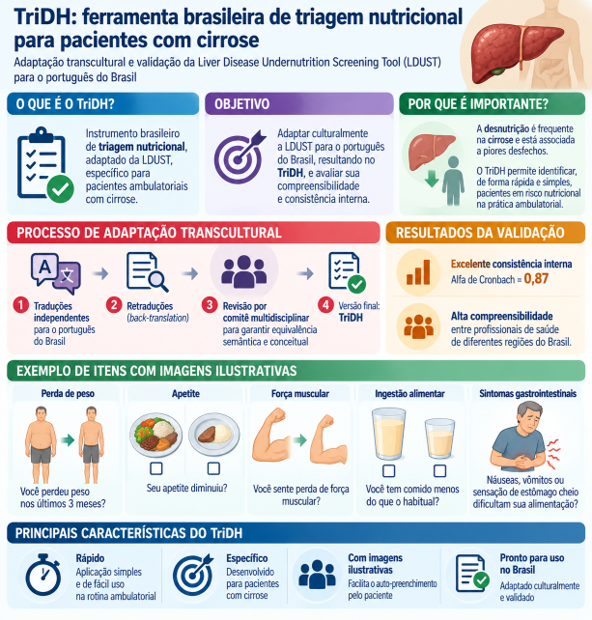
- The Liver Disease Undernutrition Screening Tool (LDUST) was cross-culturally adapted into Brazilian Portuguese, resulting in the TriDH instrument.
- The process followed a rigorous methodology including independent translations, back-translations, and a multidisciplinary committee review to ensure semantic and conceptual equivalence.
- The TriDH showed excellent internal consistency (Cronbach’s alpha = 0.87) and high comprehensibility among healthcare professionals nationwide.
- Illustrative images were incorporated to facilitate patient self-administration, providing a rapid and specific nutritional screening tool for outpatients with cirrhosis.
ABSTRACT
Background –
Chronic liver diseases represent a relevant public health problem, and undernutrition is one of their most frequent complications, being associated with higher morbidity and mortality in patients with cirrhosis. Early identification of undernutrition risk in outpatients with liver disease is fundamental; however, there is no nutritional screening tool culturally adapted for this population in Brazil. The Liver Disease Undernutrition Screening Tool (LDUST) is a simple and validated instrument for this purpose. Objective – The objective of this study was to perform the cross-cultural adaptation of the LDUST instrument into Brazilian Portuguese. Methods – The cross-cultural adaptation process followed the methodology of Beaton et al. (2000). The original tool in English was translated into Brazilian Portuguese by two independent translators, synthesized, and back-translated by two native English translators. The multidisciplinary committee evaluated semantic, idiomatic, experiential, and conceptual equivalences, consolidating the pre-final version named Triagem de Desnutrição em Pacientes com Doença Hepática (TriDH). This version was then electronically administered to healthcare professionals from different regions of Brazil. Internal reliability was analyzed using Cronbach’s alpha, adopting a minimum acceptable value of 0.8. The study was approved by the Research Ethics Committee of the Hospital de Clínicas de Porto Alegre, and all participants signed the Informed Consent Form. Results – In the pretest, the TriDH was administered to 38 healthcare professionals. It was considered easy to understand. The questionnaire presented excellent internal consistency (Cronbach’s alpha = 0.88), with all eight items exhibiting values greater than 0.8. Conclusion – The LDUST was adapted into Portuguese, originating the TriDH. This Brazilian version demonstrated high internal consistency and adequate understanding among healthcare professionals.
AUTOR
Marina da Silva GUEDES, Mariana Segaspini GOLOMBIESKI, Nairane Pinto BOAVENTURA, Priccila ZUCHINALI, Samanta Catherine FERREIRA and Valesca DALL ALBA
