
HIGHLIGHTS
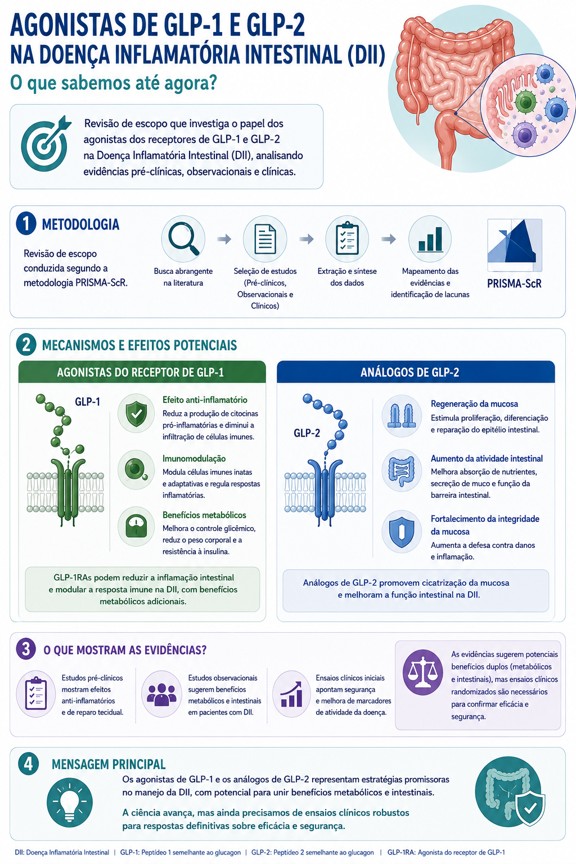
- Scoping review investigating the role of GLP-1 and GLP-2 receptor agonists in inflammatory bowel disease (IBD).
- Comprehensive analysis of preclinical, observational, and clinical studies conducted according to PRISMA-ScR methodology.
- It suggests that GLP-1 receptor agonists demonstrate anti-inflammatory and immunomodulatory effects, while GLP-2 analogs promote mucosal regeneration and intestinal activity.
- Evidence suggests potential dual metabolic and intestinal benefits; however, randomized controlled trials are still required to confirm efficacy and safety.
- Study conducted by a multidisciplinary team including a Clinical Nurse Specialist, Gastroenterologist, Endocrinologist, and General Practitioner.
ABSTRACT
Background –
Inflammatory bowel disease is a chronic, immune-mediated condition characterized by relapsing intestinal inflammation and progressive tissue damage. Despite advances in biological and small-molecule therapies, a considerable proportion of patients experience suboptimal response, treatment intolerance, or persistent disease activity. In parallel, the growing prevalence of obesity and type 2 diabetes among individuals with inflammatory bowel disease has raised interest in therapeutic agents capable of modulating both metabolic dysfunction and intestinal inflammation. Glucagon-like peptide-1 and glucagon-like peptide-2 receptor agonists have demonstrated anti-inflammatory and intestinotrophic properties in experimental and clinical settings, suggesting a potential role in this population. Objective – To systematically map and synthesize current scientific evidence regarding the effects of glucagon-like peptide-1 and glucagon-like peptide-2 receptor agonists in patients with inflammatory bowel disease. Methods – A scoping review was conducted following established methodological frameworks for evidence synthesis. A comprehensive search of electronic databases was performed to identify pre-clinical, observational, and interventional studies evaluating the effects of glucagon-like peptide-1 and glucagonlike peptide-2 receptor agonists in inflammatory bowel disease. Studies were screened according to predefined eligibility criteria. Data extraction focused on mechanisms of action, inflammatory markers, clinical outcomes, safety profile, and therapeutic implications. Results – Pre-clinical studies consistently demonstrated that glucagon-like peptide-1 receptor agonists reduce intestinal inflammation through modulation of immune signaling pathways, suppression of pro-inflammatory cytokines, and enhancement of epithelial barrier integrity. Observational human studies suggest potential clinical benefits, including reduction in disease activity and decreased need for corticosteroid escalation in selected patients. Glucagon-like peptide-2 analogs showed pronounced effects on mucosal regeneration, epithelial proliferation, and improved nutrient absorption, particularly in patients with Crohn’s disease and intestinal failure. Overall, the available evidence indicates promising metabolic and intestinal benefits; however, most studies were limited by small sample sizes and heterogeneous designs. Conclusion – Glucagon-like peptidebased therapies represent a promising adjunctive strategy in inflammatory bowel disease due to their antiinflammatory and regenerative properties. Nevertheless, high-quality randomized controlled trials focusing on diseasespecific clinical, endoscopic, and safety outcomes are necessary to establish their efficacy and therapeutic positioning in routine care.
AUTOR
Lucas Dalvi Armond REZENDE, Camila ADOUR, Gabriel Confalonieri BERTOLDI, Marco Antônio Oliveira BRITO, Flávia Lúcia CONCEIÇÃO, Mariana Poltronieri PACHECO
