
HIGHLIGHTS
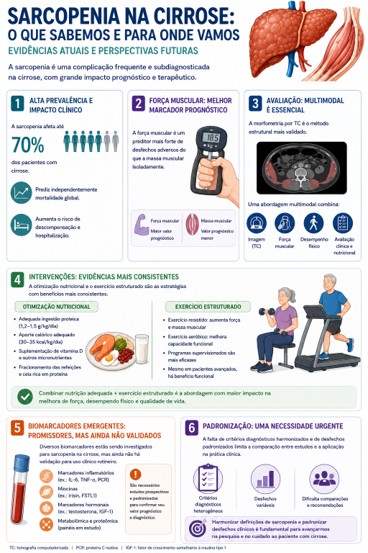
- Sarcopenia affects up to 70% of patients with cirrhosis and independently predicts mortality and decompensation.
- Muscle strength is a stronger prognostic marker than muscle mass alone.
- CT‑based morphometry is the most validated structural tool, but multimodal assessment is essential.
- Nutritional optimization and structured exercise are the most consistently beneficial interventions.
- Emerging biomarkers show promise but lack validation for clinical use.Harmonized diagnostic criteria and standardized endpoints are urgently needed.
ABSTRACT
Background –
Sarcopenia is a highly prevalent and clinically impactful complication of cirrhosis, affecting 30–70% of patients depending on diagnostic criteria and disease stage. It is strongly associated with increased mortality, hepatic decompensation, infections, waitlist dropout, and inferior posttransplant outcomes. Despite growing recognition, the field remains limited by heterogeneous definitions, lack of standardized cutoffs, and inconsistent integration of functional and structural assessments. Objective and Methods – This narrative review synthesizes mechanistic pathways linking cirrhosis to muscle wasting, including hyperammonemia, anabolic resistance, systemic inflammation, hormonal dysregulation, and mitochondrial dysfunction, and critically evaluates current diagnostic tools such as CT morphometry, DEXA, BIA, and functional performance tests. Emerging biomarkers (myostatin, irisin, metabolomic signatures) and artificial intelligence–based imaging approaches are discussed as promising but still immature tools requiring validation. Conclusion – Therapeutic strategies remain constrained by low-quality evidence, with nutritional optimization, resistance training, and management of hepatic complications forming the cornerstone of care. Novel anabolic and anticatabolic therapies show potential but lack robust clinical trial data. Standardization of diagnostic criteria, integration of multimodal assessments, and development of targeted interventions represent urgent priorities to improve outcomes in cirrhosis-associated sarcopenia.
AUTOR
Aloma Conceição Magno CAMPECHE-LEÃO, Monalisa Reis ARRUDA, Ana Clara Vital BATISTA, Lais Spindola GARCEZ, Rosangela Passos de JESUS, Helma Pinchemel COTRIM and Lourianne Nascimento CAVALCANTE
