
HIGHLIGHTS
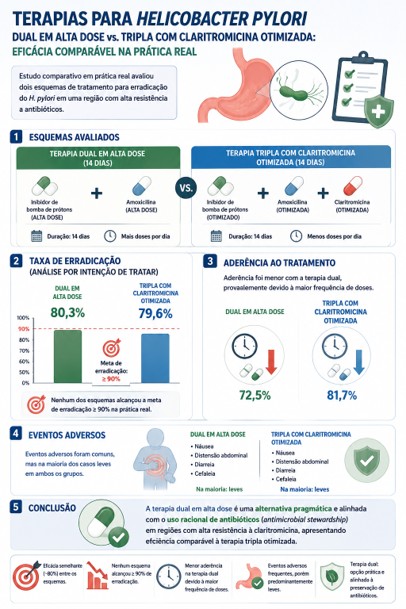
- High-dose dual therapy and optimized clarithromycin triple therapy showed comparable eradication rates (~80%).
- Neither regimen achieved the ≥90% target eradication threshold in realworld practice.
- Adherence was lower with dual therapy, likely due to higher dosing frequency.
- Adverse events were common but mostly mild in both groups.
- High-dose dual therapy represents a pragmatic, stewardship-aligned alternative in high-resistance settings.
ABSTRACT
Background –
Helicobacter pylori eradication rates have declined globally due to rising antibiotic resistance, challenging the effectiveness of standard triple therapy. High-dose dual therapy has emerged as a simplified alternative supported by pharmacodynamic rationale. We aimed to compare the real-world effectiveness, adherence, and safety of high-dose dual therapy versus optimized clarithromycin-based triple therapy in routine gastroenterology practice. Methods – We conducted a prospective, multicenter observational cohort study in adult patients with confirmed H. pylori infection treated with either high-dose dual therapy (amoxicillin 1 g three times daily plus esomeprazole 40 mg three times daily for 14 days) or optimized clarithromycin-based triple therapy (amoxicillin 1 g twice daily, clarithromycin 500 mg twice daily, and esomeprazole 40 mg twice daily for 14 days) according to physician decision. Eradication was assessed by carbon-14 urea breath test ≥4 weeks after therapy. Comparative effectiveness was estimated with effect measures, 95% confidence intervals (CI), and predefined sensitivity analyses for incomplete test-of-cure follow-up. Results – Among 218 treated patients, 104 completed post-treatment breath testing. Eradication rates were 81.3% with high-dose dual therapy and 80.4% with triple therapy (absolute difference, +0.9%; 95%CI -14.9% to +16.7%; P=0.91). Moderate-to-high adherence was observed in 51.5% vs 67.6%, respectively (P=0.19). Adverse events were more frequent with high-dose dual therapy (70.8% vs 58.9%), although the difference was not statistically significant. Mainly gastrointestinal intolerance and taste disturbance. Sensitivity analyses across plausible missing-outcome scenarios showed stable comparative results. Conclusion – In prospective real-world practice, high-dose dual therapy achieved eradication effectiveness comparable to optimized triple therapy, with favorable tolerability. These findings support high-dose dual therapy as a pragmatic and clinically attractive alternative in settings with evolving resistance and adherence constraints.
AUTOR
Alejandro UGARTE LASTRA, David E. ADVINCULA SOLIS, Harold RAMOS MAMANI, Hugo Guillermo CEDRÓN CHENG, Álvaro BELLIDO-CAPARO, Dora MONTEZUMA CALVO, Eduardo VESCO MONTEAGUDO, Günther POPPELE MOLINA, Juan Antonio CHIRINOS VEGA, Jorge ESPINOZA-RÍOS, Juan Sebastián FRÍAS-ORDOÑEZ, Víctor AGUILAR SÁNCHEZ, José Luis PINTO VALDIVIA and Jorge HUERTA MERCADO TENORIO
