
HIGHLIGHTS
- There are scarcity of data about the use of T and B lymphocytes as biomarkers for the outcome of patients with colorectal cancer.
- It was performed the staining of T and B lymphocytes subsets in the peripheral blood of patients with colorectal cancer and these findings were correlated with the patients outcome.
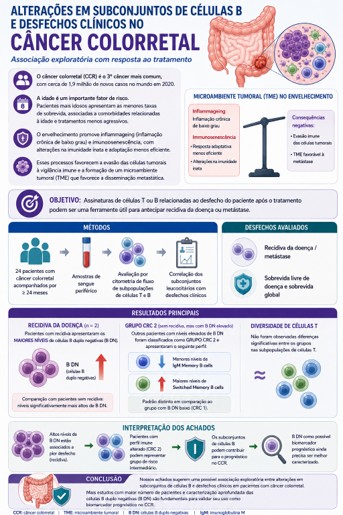
- Two patients with disease relapse after CRC treatment presented higher percentages of B double negative lymphocytes.
ABSTRACT
Background –
Colorectal cancer (CRC) is the third more common cancer with around 1.9 million people diagnosed in 2020. Age is an important risk factor for CRC development and older patients have the lowest survival rates which has been associated with age-related comorbidities and less aggressive treatment. Older individuals present a systemic low-level of chronic inflammation (inflammageing) and, at the same time, they develop a less efficient adaptive immune response, in addition to the changes in innate immunity with an overall negative impact in the immune response (immunosenescence). These processes contribute for tumor cell evasion of the immune surveillance and development of a tumor microenvironment (TME) favorable for metastatic spread. Objective – T or B cell signature related to the patient outcome after therapy could be a very useful tool to anticipate the treatment of disease relapse or metastasis. Methods – We evaluated 24 patients with CRC in a follow-up of at least 24 months and correlated with T and B cells subsets. Results – We found that patients with disease relapse (n=2) presented the highest levels of double negative B cells (B DN). Other patients with high levels of B DN were classified as CRC 2 group and presented also lower IgM memory and higher switched memory B cells. Conclusion – Our findings suggest a possible exploratory association between alterations in B-cell subsets and clinical outcomes. A higher number of patients and further characterization of DN B cells are fundamental to use these cells as prognostic biomarker in CRC.
AUTOR
Valquiria BUENO, Juliana do Carmo Barros SANTOS, Daniela FRASCA and Nora Manoukian FORONES
