
HIGHLIGHTS
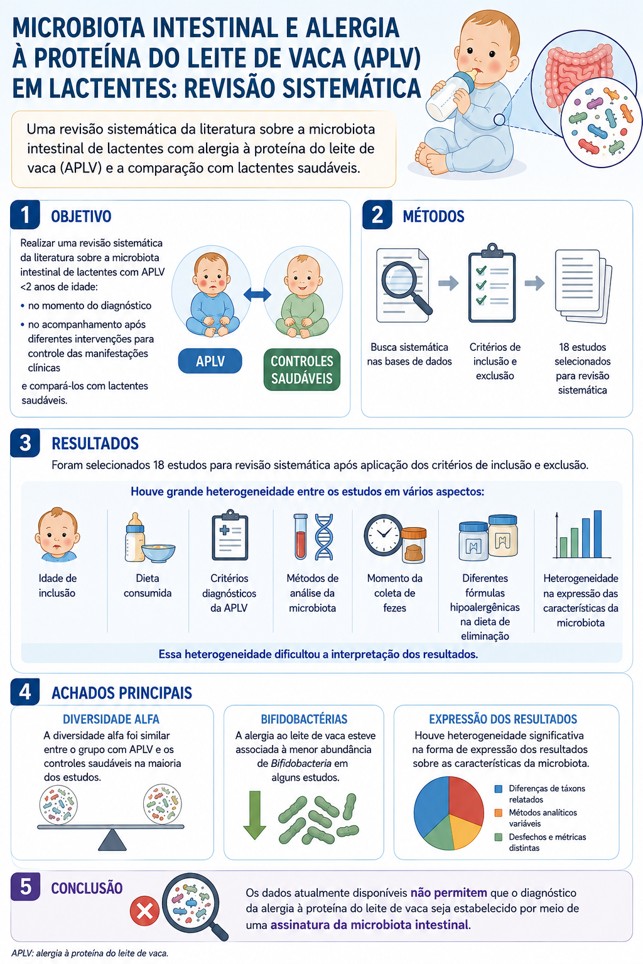
- This study aimed to conduct a systematic review of the literature on the gut microbiota of infants with cow milk allergy.
- We included studies on the gut microbiota of infants aged <2 years with cow milk allergy at diagnosis and at follow-up after different interventions in controlling clinical manifestationsand compared them with that of healthy controls.
- Eighteen studies were selected for systematic review after applying inclusion and exclusion criteria. There was significant heterogeneity in age of inclusion in the studies, diet consumed, diagnostic criteria for cow milk allergy, methods for analyzing the gut microbiota, timing of stool analysis, different hypoallergenic formulas during elimination diet, and heterogeneity in the expression of microbiota characteristics, thereby hindering interpretation of results. Significant heterogeneity was observed in the expression of results on microbiota characteristics. Alpha diversity was similar in study group and in the control group of most studies. Allergy to cow milk was associated with low involvement of Bifidobacteria in some studies.
- Therefore, currently available data do not allow the diagnosis of cow milk allergy to be established through a microbiota signature.
ABSTRACT
Background –
Alterations in the gut microbiota may be involved in the pathophysiology of cow milk allergy (CMA). However, whether gut microbiota abnormalities contribute to the diagnostic confirmation of CMA through specific microbiome signatures is still unknown. Objective – To conduct a systematic review of the literature on the gut microbiota of infants with CMA. Methods – This systematic review included studies on the gut microbiota of infants aged <2 years with CMA at diagnosis and at follow-up after different interventions to control clinical manifestations and compared them with that of healthy controls. The PubMed database was used for literature search. The Preferred Reporting Items for Systematic Reviews and MetaAnalyses protocol was applied. This review was registered on the PROSPERO platform (CRD42024574354). Results – A total of 1,096 articles were identified. After applying inclusion and exclusion criteria, 18 studies were selected for the systematic review. Clinical manifestations included infants with immunoglobulin E (IgE)-mediated CMA (n=7), those with non-IgE-mediated CMA (n=10), or both (n=1). An oral challenge test for CMA diagnosis was mentioned in 11 studies, and in seven of them, a double-blind placebo-controlled challenge test was used. Most studies (n=13) used 16S rRNA gene sequencing to investigate the intestinal microbiota, and only three studies used shotgun metagenomic analysis. There was significant heterogeneity in the expression of results on microbiota characteristics. Alpha diversity was similar in the
control group in most studies. A low abundance of Bifidobacteria was observed in some studies (n=5). Conclusion – The results of this systematic review did not identify a typical microbiota pattern in infants with CMA. Studies including infants before elimination diet and with a diagnosis confirmed by an oral challenge test, and studies including one group of infants of the same age on exclusive breastfeeding and another group of infants of the same age on formula feeding as a control group are needed. Therefore, currently available data do not allow CMA diagnosis through a microbiota signature.
AUTOR
Marcela Duarte de SILLOS, Juliana Satomi de Souza MATSUO and Mauro Batista de MORAIS
