
HIGHLIGHTS
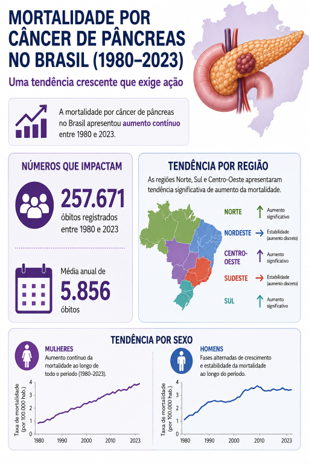
- Pancreatic cancer mortality in Brazil showed a continuous increase between 1980 and 2023. A total of 257,671 deaths were recorded during this period, with an annual average of 5,856 deaths.
- The North, South, and Central-West regions showed significant upward trends in mortality. A continuous increase in mortality was observed among women, while men showed alternating phases of growth and stability.
- The results reflect global trends and reinforce the need for targeted strategies for prevention, early diagnosis, and equitable access to treatment
ABSTRACT
Background –
Pancreatic cancer (PC) is a highly lethal malignancy with rising incidence and mortality rates, although its burden remains poorly investigated in Brazil. Understanding its regional and sex-specific trends is critical for tailoring public health interventions and mitigating the disease’s impact in the Brazilian population. Objective – This study aimed to evaluate the temporal trends in PC mortality among Brazilian individuals between 1980 and 2023 and its alignment with the global projections. Methods – This retrospective, population-based ecological study analyzed PC mortality data using the Sistema de Informação de Mortalidade (SIM) and demographic data from the Instituto Brasileiro de Geografia e Estatística (IBGE). Annual Percent Change (APC) calculations were performed to assess temporal trends by Brazilian geographic regions and sex, accounting for demographic shifts over time. Results – A total of 257,671 PC-related deaths occurred during the study period, averaging 5,856 deaths per year. The overall mortality trend for PC in Brazil showed a continuous increase of (APC: 1.23; 95%CI: 1.16-1.32; P-value <0.01). Regional analyses revealed significant increases in the North (APC: 2.32), South (APC: 0.59), and Midwest (APC: 1.45) regions. Sex-specific trends indicated a steady increase for women throughout the period, while men experienced alternating phases of rising and stationary trends. Conclusion – PC mortality in Brazil has risen significantly over the past four decades, with marked regional and sex-specific disparities, aligning with global perspectives. These findings highlight the need for targeted PC prevention, early detection, and equitable access to high-quality cancer care, particularly in vulnerable regions and populations.
AUTOR
Lucas Casagrande Passoni LOPES, Isabela Ussifati NEGRINE and Carlos Antonio NEGRATO
