
HIGHLIGHTS
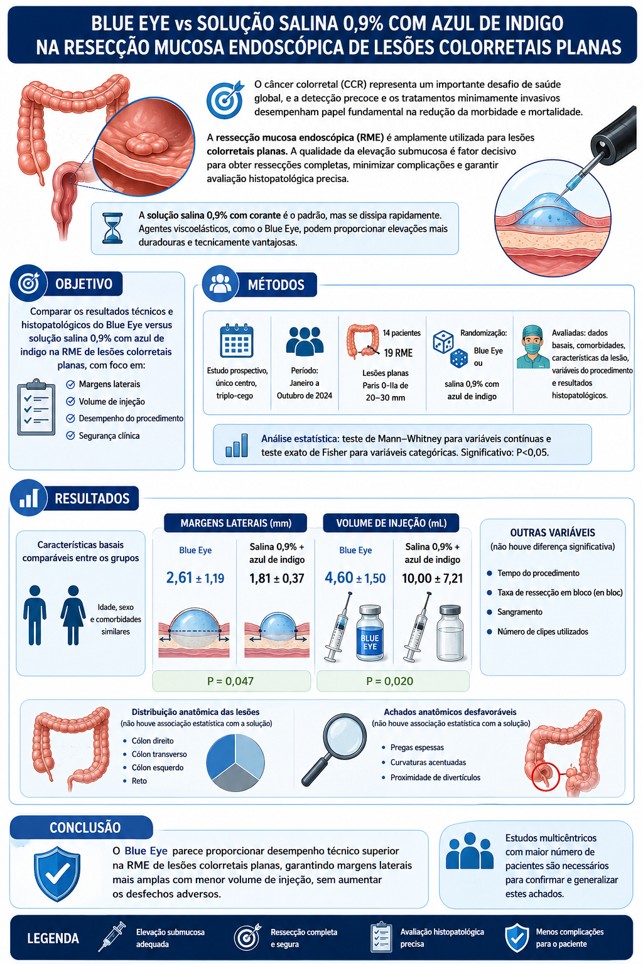
- Blue Eye solution provided significantly wider lateral margins compared to saline with indigo carmine in EMR of flat colonic lesions.
- Lower injection volumes were required with Blue Eye, reducing procedural manipulation.
- Clinical and safety outcomes were similar between groups, with no increase in adverse events.
- Blue Eye demonstrates potential as a superior submucosal injectate, warranting validation in larger multicenter trials.
ABSTRACT
Background –
Colorectal cancer (CRC) represents a significant global health challenge, with early detection and minimally invasive treatments playing key roles in reducing morbidity and mortality. Endoscopic mucosal resection (EMR) is widely employed for flat colonic lesions, and the quality of submucosal elevation is a decisive factor for achieving complete resections, minimizing complications, and ensuring accurate histopathological assessment. Conventional 0.9% saline with dye is the standard solution but dissipates rapidly, while viscoelastic agents such as Blue Eye may offer more durable and technically advantageous lifts. Objectives – This study aimed to compare the technical and histopathological outcomes of Blue Eye versus 0.9% saline with indigo carmine in EMR of flat colonic lesions, focusing on lateral margins, injection volume, procedural performance, and clinical safety. Methods – A prospective, single-center, triple-blind study was conducted between January and October 2024, including 14 patients undergoing 19 EMRs for Paris 0-IIa flat colonic lesions sized 20–30 mm. Patients were randomized to receive either Blue Eye or saline with indigo carmine. Baseline demographics, comorbidities, lesion features, procedural variables, and histopathological outcomes were collected. Statistical analysis included the Mann–Whitney test for continuous variables and Fisher’s exact test for categorical data, adopting P<0.05 as significant. Results – Baseline characteristics were comparable between groups regarding age, sex, and comorbidities. Blue Eye demonstrated significantly larger lateral margins (2.61±1.19 mm vs 1.81±0.37 mm, P=0.047) and required lower injection volume (4.60±1.50 mL vs 10.00±7.21 mL, P=0.020). Other variables, including procedure time, en bloc resection rate, bleeding, and number of clips, did not differ significantly. Anatomical lesion distribution and unfavorable anatomical findings also showed no statistical association with the solution employed. Conclusion – Blue Eye appears to provide superior technical performance in EMR of flat colonic lesions by ensuring wider lateral margins with less injection volume, without increasing adverse outcomes. Larger multicenter studies are needed to confirm and generalize these findings.
AUTORES
Caio Colturato COIMBRA, Isabela Franzon Leopize DA GAMA, Roberto Luiz KAISER JUNIOR, Fernando Tadeu Vannucci COIMBRA, Carolina Colombelli PACCA and Luiz Gustavo de QUADROS
