HIGHLIGHTS
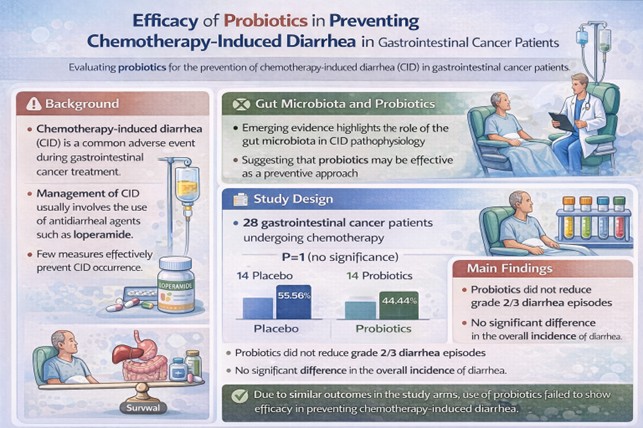
- Chemotherapy-induced diarrhea (CID) is a common adverse event during the treatment for gastrointestinal cancers.
- Management of CID usually involves the use of antidiarrheal agents such as loperamide; however, few measures are effective in preventing its occurrence.
- Emerging evidence has demonstrated the role of gut microbiota in the pathophysiology of CID, suggesting that probiotics may be effective as a preventive approach.
ABSTRACT
Background –
Chemotherapy-induced diarrhea is a common and distressing side effect experienced by patients undergoing cancer treatment, particularly those with gastrointestinal cancer. It can lead to significant health complications, including dehydration, electrolyte imbalances, and treatment interruptions. Recent studies have shown that the gut microbiome plays an important role in the development and severity of chemotherapy-induced diarrhea. Modulating the gut microbiome with probiotics has emerged as a potential strategy for preventing and managing chemotherapy-induced diarrhea. Objective – In this study we aimed to evaluate the efficacy of one probiotic containing a mixture of several strains of Lactobacillus and Bifidobacterium species in prevention of chemotherapy induced diarrhea among patients with gastrointestinal cancer. Methods – Between April 2022 and June 2024, a total of 28 patients diagnosed with gastrointestinal cancer who were intended to receive chemotherapy based on fluoropyrimidine, oxaliplatin, and/or irinotecan were randomized in a ratio 1:1 to receive either a placebo or 20 billion colonyforming units (CFU) of a mixture containing five viable strains including 335 mg of Lactobacillus acidophilus NCFM®, Lactobacillus paracasei Lpc-37TM, Bifidobacterium lactis Bi-04TM, Bifidobacterium lactis Bi-07TM, and Bifidobacterium bifidum Bb-02TM. Patients were instructed to take the product orally once daily for 90 days and to record their bowel habits in a diary using the Bristol stool scale. Results – The use of probiotics, compared to placebo, did not result in reduction of grade 2/3 diarrhea episodes (placebo arm 55.56% vs probiotic arm 44.44%; P=1). Likewise, no statistically significant difference was observed in the overall incidence of diarrhea between the two groups (71.43% vs 64.29%; P=1). The median number of diarrhea episodes during the 90-day follow-up tended to be lower in the probiotic group (eight episodes) compared to the placebo group (9 episodes) (P=0.639) Subgroup analyses failed to identify any specific patient characteristics that associated any benefit from the probiotic use, regardless of diarrhea grade. Also, no infections related to the probiotic strains administered in this study were detected. Conclusion – Probiotic in comparison to a placebo did not result in a statistically significant effect, suggesting a lack of benefit of administered probiotic for prevention of chemotherapy induced diarrhea among patients with gastrointestinal cancer.
AUTORES
Gabriel Caio DE SOUZA, Humberto Bezerra de ARAUJO FILHO, Cleyton Zanardo DE OLIVEIRA, Ana Paula Ribeiro PAIOTTI and Nora Manoukian FORONES