HIGHLIGHTS
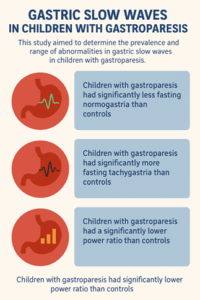
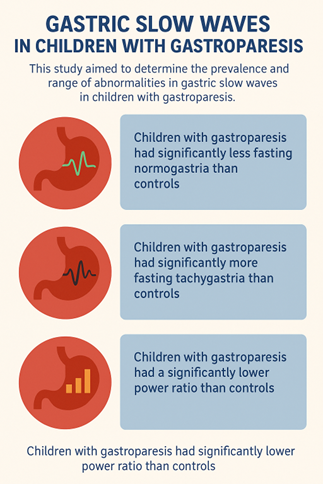
- This study aimed to determine the prevalence and range of abnormalities in gastric slow waves in children with gastroparesis.
- Children with gastroparesis had significantly less fasting normogastria than controls.
- Children with gastroparesis had significantly more fasting tachygastria than controls.
- Children with gastroparesis had a significantly lower power ratio than controls.
ABSTRACT
Background –
Gastroparesis is a delay in gastric emptying without mechanical obstruction, lacking a clear pathophysiological mechanism, but with multiple histological abnormalities, including loss of interstitial cells of Cajal, which may alter slow waves. Slow waves can be assessed by electrogastrography. Objective – This study aimed to determine the prevalence and range of abnormalities in gastric slow waves in children with gastroparesis. Methods – We conducted a systematic review and meta-analysis following the Preferred Reporting Items for Systematic Reviews and Meta-Analyses guidelines (PROSPERO: CRD42023435301). Searches were performed in MEDLINE (PubMed), Embase, LILACS, Web of Science, and the Cochrane Register of Controlled Trials, from inception to September 2023, without language or publication restrictions. We included studies using surface electrogastrography in children (6–18 years) with gastroparesis. Outcomes included the percentage of recording time in normogastria (2–4 cycles per minute), tachygastria, and bradygastria; dominant frequency; power ratio; post-stimulus power change; and dominant frequency instability coefficient. Risk of bias was assessed using the Joanna Briggs Institute tool. Meta-analyses were conducted using random-effects models when appropriate, and heterogeneity was explored via the I² statistic and prediction intervals. When pooling was not feasible, a narrative synthesis was provided. Results – A total of 3730 articles were reviewed, four articles were included, with a total of 70 patients and 15 controls. When compared to controls, gastroparetics had significantly less fasting normogastria (Standardized Mean Difference = -3.363 [95% confidence interval: -4.068 to -2.657]), significantly more fasting tachygastria (Standardized Mean Difference = 3.287 [95% confidence interval: 2.657 to 3.918]), and significantly less power ratio (Standardized Mean Difference = -4.067 [95% confidence interval: -4.791 to -3.343]). Conclusion – Children with gastroparesis during fasting had a lower percentage of normogastria and higher percentage of tachygastria. Children with gastroparesis showed less change in post-stimulus power, reflecting possible alterations in gastric contraction and/or distension.
AUTORES
Juan Javier PERALTA-PALMEZANO, Diana Paola ESCOBAR-SERNA, Fernando Javier PERALTA-PALMEZANO, Nancy Rocio ACOSTA-MURILLO and Rafael GUERRERO-LOZANO