HIGHLIGHTS
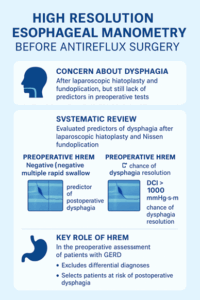
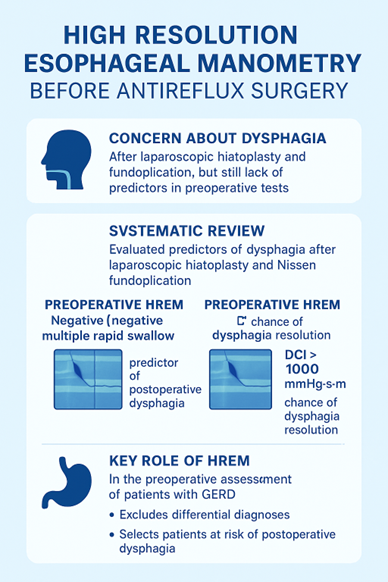
- There is great concern about dysphagia after laparoscopic hiatoplasty and fundoplication, but still lack predictors factors of preoperative tests.
- We carried out a systematic review aimming of evaluating the High Resolution Esophageal Manometry (HREM) and the predictors of dysphagia after laparoscopic hiatoplasty and Nissen fundoplication. Patients with negative multiple rapid swallow test (MRST) in the preoperative HREM is a predictor of postoperative dysphagia. Among patients with preoperative dysphagia, there is a considerable chance of it being resolved after hiatoplasty and fundoplication if they have an DCI >1000 mmHg.s.cm on the preoperative HREM.
- HREM plays a key role in the preoperative assessment of patients with GERD, excluding differential diagnoses and helping select patients with risk of postoperative dysphagia.
ABSTRACT
Background –
Gastroesophageal reflux disease has a prevalence of 12% in the Brazilian population. Its treatment includes hygienic-dietary changes, use of medications and, in selected cases, surgery with laparoscopic hiatoplasty and Nissen total fundoplication. However, this last treatment modality presents risks of postoperative dysphagia. High Resolution Esophageal Manometry (HREM) has been considered the test of choice for identifying patients who are candidates for surgical treatment at an increased risk of developing dysphagia. Objective – The objective of this study is to carry out a systematic review to evaluate the clinical and manometric factors that predict post-hiatoplasty and Nissen fundoplication dysphagia using HREM. Methods and results – Having defined the search engine, we used the databases MEDLINE, PUBMED, EBSCOHOST, SCOPUS and EMBASE. 2147 articles were identified. After selection, 11 studies remained. Conclusion – We concluded that the data from the selected articles are heterogeneous, but there is agreement regarding a higher risk of dysphagia among female patients, patients with dysphagia present in the preoperative period and, about manometric parameters, for patients with dysphagia in the preoperative period, there is a higher incidence of dysphagia resolution for patients with DCI >1000 mmHg.s.cm. In patients with ineffective esophageal motility, it is recommended to perform the Rapid Multiple Swallowing Test to assess the contractile reserve of the esophageal body. If there is an increase in contractile strength with this test, it is considered safe to perform a total fundoplication because the incidence of late dysphagia is low in these cases.
AUTORES
Ary Augusto de Castro MACEDO, Danielle Patriota SAMPAIO, Natalie Cavalcanti Mareco da SILVA, Luigi Carlo da Silva COSTA, Nelson Adami ANDREOLLO and Luiz Roberto LOPES