HIGHLIGHTS
- Primary studies on small intestinal bacterial overgrowth (SIBO) by using breath tests in patients with cystic fibrosis were analyzed.
- We selected and synthesized the data using the PRISMA methodology.
- Nine included studies described the prevalence of SIBO between 31.6 and 71%, higher than that of healthy controls (7 to 20%), however breath tests methodologies varied widely and were not comparable.
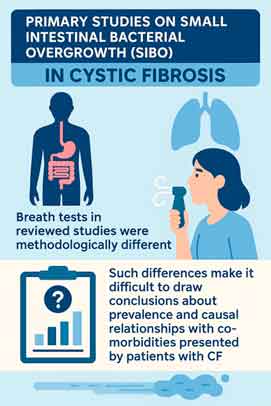
- Breath tests used in reviewed studies were methodologically different, and such differences make it difficult to draw conclusions about prevalence and causal relationships with co-morbidities presented by patients with CF.
ABSTRACT
Background –
In patients with cystic fibrosis (pwCF) acid suppression therapy, gastrointestinal dysmotility, and post-operative bowel status, may predispose to the development of small intestinal bacterial overgrowth (SIBO). SIBO may continue to be present in the progression of the disease even on modulators. Breath testing is the most simple, noninvasive and available method for diagnosing SIBO. There are some divergencies over the operational procedures used to carry out and interpret breath tests in pwCF. Objective – We performed a systematic review of SIBO in pwCF to assess the methods used in breath tests and the existence of causal relationship between SIBO and following CF co-morbidities: liver disease, fat absorption, and eating disorders. Methods – We searched the PubMed, Cochrane Library, Embase, LILACS, MEDLINE, OpenGray, medRxiv, Google Scholar, and CAPES databases up to March 20, 2024. We selected clinical cohort and case-control studies to assess SIBO in cwCF. We selected studies that met the following criteria: (1) participants – children and adolescents diagnosed with CF; (2) intervention – assessment of SIBO using H2 and CH4 breath tests; (3) control – patients without SIBO; and (4) outcome – assessment of breath tests for SIBO diagnosis and the causal relationship between SIBO and CF co-morbidities. The PRISMA statement was used to report the search. QUADAS 2 tool was used for assessing the quality of each study methodology. The protocol for this review was registered in the Prospective Registration of Systematic Review Database (CRD42024503593). Results – The search strategy identified 279 studies. After screening titles and abstracts, 36 studies were selected for full-text review and 27 were excluded; nine studies involving 206 pwCFs were reviewed. All nine studies used H2 breath tests as a diagnostic method for SIBO, and five of them used a combined H2/CH4 test. There was no consistency in the timing of cessation of antibiotic therapy prior to testing. All patients performed the test after an overnight fast. A basal sample was collected prior to substrate (glucose or lactulose) ingestion, which ranged from 7 to 20 ppm. There was great variability between respiratory sample collection times, being times 0, 15, 30, 45, 60, 90, and 120 minutes the most used protocol. The methods for performing breath tests varied widely, making it difficult to reach conclusions on the role of SIBO as a comorbidity in pwCF. There was no association between increased serum AST, ALT, and GGT levels and positive breath tests. There was no agreement regarding the role of SIBO and nutritional deficiency, but a reduction in fat absorption and the presence of hyporexia have been described under this condition. Conclusion – Data on assessment of SIBO in pwCF is limited by the small number of studies available, the lack of appropriate controls in some studies, and the varying test methodology and diagnostic cut-offs applied. Protocols to investigate and diagnosing SIBO in pwCF need to be developed.
AUTORES
Maria Lidiane Lavor LANDIM, José Dirceu RIBEIRO, Daniela de Souza Paiva BORGLI, Danielle Rossana Queiroz Martins BONILHA, Elizete Aparecida LOMAZI and Maria de Fátima Correa Pimenta SERVIDONI*