
HIGHLIGHTS
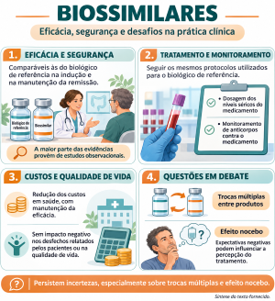
- Biosimilars demonstrate efficacy and safety comparable to those of the originator in both inducing and maintaining remission. However, most supporting evidence derives from observational studies.
- Treatment and tracking protocols should utilize biosimilars in the same manner as biologic originators, including the assessment of serum levels and antibody monitoring.
- The adoption of biosimilars is associated with diminished healthcare costs while maintaining efficacy and without adversely affecting patient-reported outcomes or quality of life.
- The most debated aspects of biosimilar use include multiple switching between products and the nocebo effect. This article discusses the uncertainties regarding this subject.
ABSTRACT
Background –
Biologics improve outcomes in inflammatory bowel disease, but high costs restrict access and strain healthcare resources. Biosimilars lower costs, expand access, and support sustainable IBD care. Objective – Provide clear, evidence-based answers on biosimilar use in IBD across clinical, therapeutic, and economic domains to guide safe implementation and informed decision-making. Methods – GEDIIB conducted a PICO-structured systematic review across multiple databases and trial registries. We extracted clinically relevant outcomes and performed systematic review. We assessed risk of bias with RoB 2.0 and ROBINS-I and graded certainty using GRADE. A structured Delphi process with two voting rounds and external validation finalized recommendations, with consensus predefined at 85 percent or higher. Results – Anti-TNF biosimilars and originator biologics have similar efficacy, safety, immunogenicity, treatment persistence, and mucosal healing in biologic-naive patients and after switching, with no clinically meaningful differences in adverse events, loss of response, or discontinuation. Data on multiple switches do not indicate harm, though evidence remains limited. Pediatric studies suggest similar profiles, with lower precision. Economic evaluations show substantial cost savings and improved access, supporting the sustainability of the health system. Conclusion – Biosimilars represent a viable, safe, and cost-effective option for IBD management. We recommend structured switching strategies, clear communication with patients, and continuous clinical monitoring. Additional robust studies should strengthen evidence in specific populations and clinical scenarios.
AUTOR
Cristina Flores, Francisco Guilherme Cancella Penna, Marcello Imbrizi, Adalberta Lima Martins, Renata de Sá Brito Fróes, Munique Kurtz de Mello, Stefania Burjack Gabriel, Licia Maria Rodrigues, Ligia Yukie Sassaki, Marjorie Costa Argollo, Fabio Vieira Teixeira, Jane Oba, Eduardo Garcia Vilela, Rogério Saad-Hossne, Matheus Freitas Cardoso de Azevedo, Júlio Maria Fonseca Chebli, José Miguel Luz Parente, Aderson Omar Mourão Cintra Damião, Eloá Marussi Morsoletto, Vera Lucia Sdepanian, Rogerio Serafim Parra and Paulo Gustavo kotze
