
HIGHLIGHTS
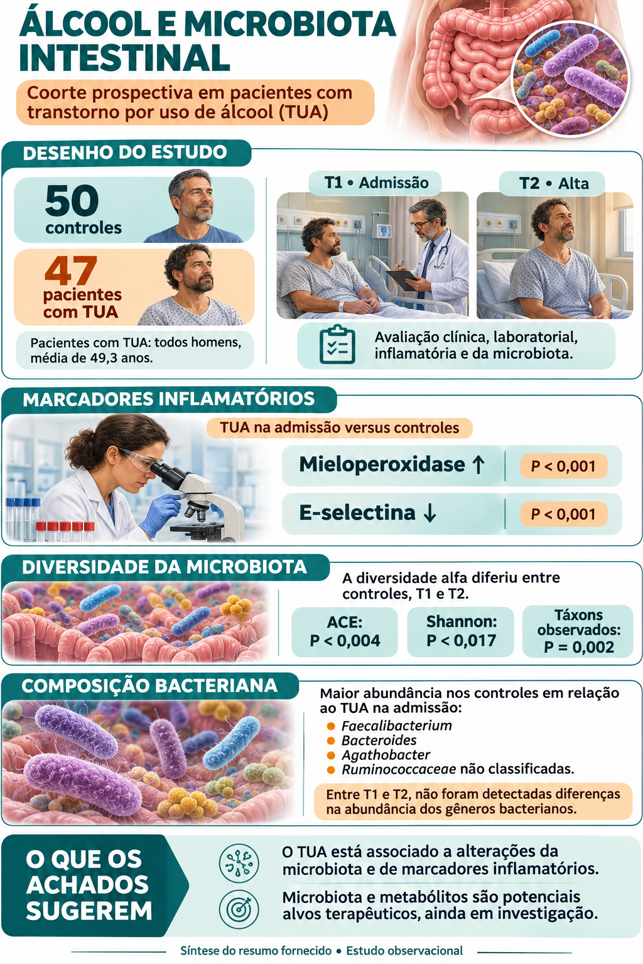
- Chronic alcohol consumption is associated with gut microbiota dysbiosis.
- Alcohol use disorder patients show distinct inflammatory marker profiles compared to healthy controls.
- Reduced abundance of key commensal bacteria may contribute to alcohol-related disease mechanisms.
- Gut microbiota abnormalities persist despite short-term alcohol withdrawal.
ABSTRACT
Background and objectives – Alcohol Use Disorder (AUD) is a global issue with a significant financial impact on health. The main objective of this study was to assess the chronic effect of alcohol on the composition and diversity of intestinal microbiota in AUD patients. Methods – Prospective cohort study in patients hospitalized for AUD treatment. Demographic, clinical, and laboratory data and inflammatory markers were assessed at the time of hospital admission for AUD-T1- group and in the control group, as well evaluation of the gut microbiota composition, while the AUD-T2-group was assessed at the discharge from hospital treatment. Results – 50 participants were included in the control group and 47 admitted for AUD treatment. The mean age in the AUD-T1-group was 49.3 years, all male. Mieloperoxidase concentration was significantly higher in AUD-T1-group compared to control (P<0.001). The opposite was observed for E-selectin (P<0.001). Global alpha diversity was different among the control, AUD-T1 and AUD-T2 groups, ACE index (P<0.004), Shannon index (P<0.017), observed taxa (P=0.002). The LEfSe algorithm identified a higher abundance of Faecalibacterium, Bacteroides, Agathobacter, and Ruminococcaceae unclassified in control compared to the AUD-T1. There were no differences in the abundance of bacterial genera between the AUD-T1 and AUD-T2 groups. Conclusion – Patients with AUD exhibit changes in intestinal microbiota composition, potentially associated with low-grade inflammation and functional alterations that contribute to the development of diseases. The composition of intestinal microbiota and its bioactive metabolites may serve as novel therapeutic targets for the treatment of AUD.
AUTORES
Rutiane Ullmann THOEN, Larisse LONGO, Bruno de Souza BASSO, Pabulo Henrique RAMPELOTTO, Anne Orgler SORDI, Félix Henrique Paim KESSLER, Lisia Von DIEMEN, Mário Reis ÁLVARES-DA-SILVA
