
HIGHLIGHTS
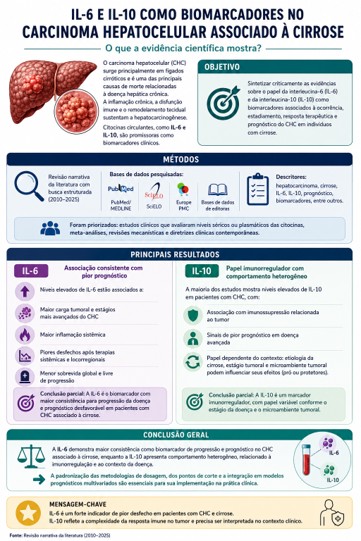
- This narrative review critically synthesizes evidence on the role of IL-6 and IL-10 as inflammatory biomarkers in cirrhosis-associated hepatocellular carcinoma.
- A structured literature search was conducted, with qualitative and comparative analysis of key clinical, mechanistic, and prognostic studies.
- The findings indicate a consistent association between elevated IL-6 levels, tumor progression, impaired liver function, and reduced survival, whereas IL-10 exhibits context- and stage-dependent behavior.
- IL-6 emerges as a robust prognostic biomarker, while IL-10 may add value within multimarker panels and integrated prognostic models.
ABSTRACT
Background –
Hepatocellular carcinoma (HCC) arises predominantly in cirrhotic livers and remains one of the leading causes of mortality related to chronic liver disease. Chronic inflammation, immune dysfunction, and tissue remodeling sustain hepatocarcinogenesis, making circulating cytokines promising candidates for clinical biomarkers. Objective – To critically synthesize evidence on the role of interleukin-6 (IL-6) and interleukin-10 (IL-10) as biomarkers associated with HCC occurrence, staging, therapeutic response, and prognosis in individuals with cirrhosis. Methods – A narrative review was performed based on a structured literature search in PubMed/MEDLINE, SciELO, Europe PMC, and publishers’ databases (2010–2025), using descriptors related to hepatocellular carcinoma, cirrhosis, IL-6, IL-10, prognosis, and biomarkers. Clinical studies assessing serum or plasma cytokine levels, meta-analyses, mechanistic reviews, and contemporary clinical guidelines were prioritized. Results – The majority of clinical studies indicate a consistent association between elevated IL-6 levels and poor prognosis, increased tumor burden, systemic inflammation, and inferior outcomes following both systemic and locoregional therapies. For IL-10, the evidence supports elevated levels in a substantial proportion of patients with HCC, with signals of association with tumor-related immunosuppression and worse outcomes in advanced disease, although some studies suggest a context- and disease-stage–dependent role. Conclusion – IL-6 demonstrates greater consistency as a biomarker of progression and prognosis in cirrhosis-associated HCC, whereas IL-10 emerges as an immune regulatory marker with heterogeneous behavior depending on disease etiology, tumor stage, and the tumor microenvironment. Standardization of assay methodologies, cutoff values, and multivariable prognostic models is essential for clinical implementation.
AUTOR
Rubens Barbosa REZENDE*
