
HIGHLIGHTS
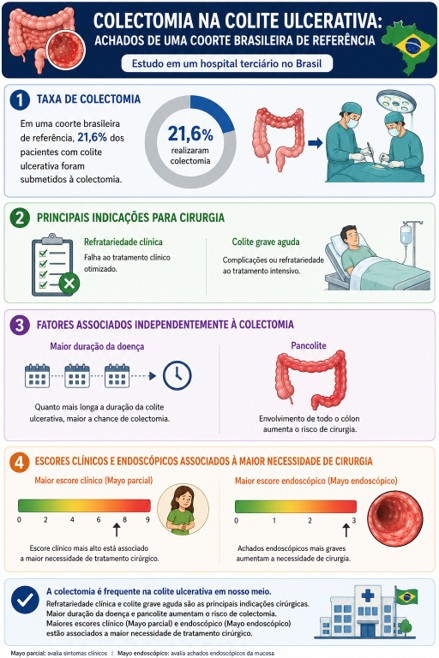
- In a tertiary Brazilian cohort, 21.6% of patients with ulcerative colitis underwent colectomy.
- Clinical refractoriness and acute severe colitis were the main indications for surgery.
- Longer disease duration and pancolitis were independently associated with colectomy.
- Higher clinical (partial Mayo) and endoscopic Mayo scores were associated with an increased need for surgical treatment.
ABSTRACT
Background –
Despite recent advances in the medical treatment of ulcerative colitis (UC) involving the use of biological agents and small molecules, a proportion of patients with UC still require surgical treatment. Objective – This study evaluated patient characteristics and factors associated with colectomy in patients with UC at a tertiary IBD center. Methods – This is a retrospective and observational study utilizing the database at our university hospital. The sample comprised 232 patients diagnosed with UC, with a mean age of 46.45±15.00 years, 60.3% of whom were women. The patients were divided into two groups depending on whether or not they had undergone colectomy between January 2001 and December 2018. Results – Of all 50 (21.6%) patients underwent colectomy. Clinical intractability (40.0%) and acute severe colitis (22%) were the main indications for colectomy. Longer disease duration (P=0.035), pancolitis (82.0% vs 6.0%; P0.05). Conclusion – Our study shows that a longer disease duration, extensive disease (pancolitis), and higher severity of UC at diagnosis were associated with a poor prognosis, culminating in a higher need for surgical intervention.
AUTORES
Sandro da Costa FERREIRA, Rogério Serafim PARRA, Gleici da Silva de Castro PERDONÁ, Rosamar Eulira Fontes REZENDE, Lílian Rose Otoboni APRILE and Omar FÉRES
