

HIGHLIGHTS
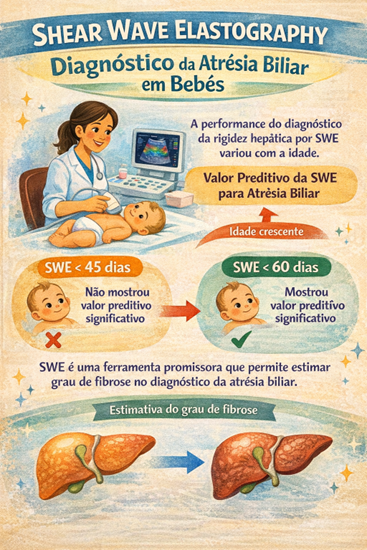
- The diagnostic performance of liver stiffness measurement by SWE changed with age.
- SWE in <45 days did not show significant predictive value for BA. However, in <60 days it did show.
- SWE is a promising tool that allows estimating the degree of fibrosis in the diagnosis of biliary atresia.
ABSTRACT
Background –
Biliary atresia (BA) is the leading cause of cholestatic jaundice in the first months of life. Liver stiffness measurement by shear wave elastography (2D–SWE) could help discriminate BA from other causes of cholestasis. Objectives – To assess the use of abdominal ultrasound with bidimensional shear wave elastography and liver histology to diagnose Biliary Atresia in cholestatic infants. To compare the use of elastography to estimate the stage of liver fibrosis with the histologic classification. Methods – Cholestatic infants younger than three months were divided into BA and non-BA groups (other than neonatal cholestasis). 2D–SWE measured liver stiffness, and fibrosis was measured by Metavir score. Receiver operator characteristic (ROC) curves were developed to assess whether the variables of liver stiffness could be used to identify patients with BA and the best cutoff values. Results – 21 infants with BA and 26 non-BA were included, of which 53,2% were males. The triangular cord was seen in 15/21 (71.4%) of BA and 2/26 (7.7%) non–BA, P<0.0001. The median value of liver stiffness in the first group was 2.7 m/s (IQ 2.1/3.6) and 1.6m/s (IQ 1.2/2) in the second group, P<0.0001. The area under the ROC curve to predict BA was 0.85 (95%CI, 0.74–0.96; P<0.0001). The best cutoff value was 1.99 m/s with sensitivity 81% and specificity 73.1%. Patients with BA classified as F0–2 had mean liver stiffness values by the 2D–SWE of 1.8±0.2m/s, and F3–4, mean values of 3±0.8m/s, P=0.008. Conclusion – Ultrasound and histology contribute to distinguishing BA from other diagnoses. Liver elastography is a promising tool in the differential diagnosis between BA and other causes of cholestasis, allowing the degree of fibrosis to be estimated at diagnosis.
AUTORES
Thais Costa Nascentes Queiroz, Rogério Auguto Pinto-Silva , Eleonora Druve Tavares Fagundes, Guilherme Domingues Ferreira, Ana Carolina Domingues Ferreira and Alexandre Rodrigues Ferreira
