

HIGHLIGHTS
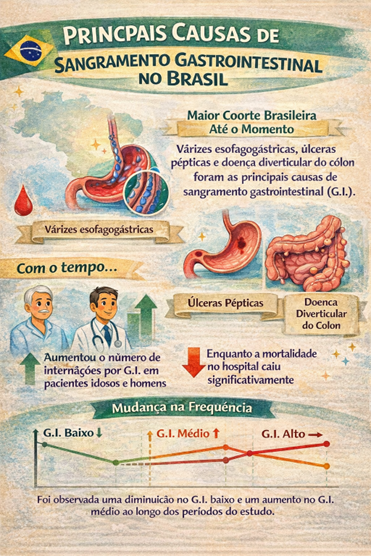
- In this largest Brazilian cohort to date, esophagogastric varices, peptic ulcers, and colonic diverticular disease were the leading causes of gastrointestinal bleeding (GIB).
- Over time, the number of admissions for GIB increased among older patients and male subjects, while in-hospital mortality significantly declined.
- A decrease in lower GIB and an increase in mid-GIB frequency was observed across the study periods
ABSTRACT
Background –
Gastrointestinal bleeding (GIB) is one of the leading causes of hospitalization attributed to digestive disorders. Little is known about etiology and outcomes of GIB and temporal trends in the incidence of upper GIB (UGIB) and lower GIB (LGIB) in Brazil. Objective – To investigate the main causes and mortality of patients admitted to a tertiary care hospital in Brazil with UGIB and LGIB, as well as to assess trends in epidemiology and outcomes of GIB over time. Methods – All patients admitted to the Gastrointestinal (GI) Unit of the Portuguese Hospital of Salvador, Bahia, Brazil with the diagnosis of GIB between January 2012 and December 2023 were retrospectively investigated. All patients with GIB were classified as non-variceal (NUGIB), variceal (VUGIB) UGIB and LGIB according to standard criteria and managed according to an institutional protocol. Demographics, type and etiology of GIB and in-hospital mortality were evaluated in two different periods, between 2012-2017 (period 1) and 2018- 2023 (period 2). Results – 2.145 patients (1.214 males, mean age 70+16 years) were admitted, 1.185 in period 1 and 960 in period 2. Most of the patients had hematochezia and melena. NUGIB, VUGIB, LGIB and mid-GIB were observed in 37.5%, 14.4%, 40.3% and 5.6% of the patients, respectively. The remaining 47 subjects were not investigated due to advanced age or comorbidity. The most common etiologies for UGIB and LGIB were, respectively, esophagogastric varices (EV), duodenal (DU) and gastric ulcer (GU), and colonic diverticular disease (CDD), actinic proctocolitis (APC) and hemorrhoids (HE). Changes in the frequency of LGIB (42.1% vs 38.0% in period 2, P<0.0001) and mid-GIB (3.8% vs 7.9% in period 2, P<0.0001) were recorded over time. Age (68.7+15.6 vs 71+15.7 years in period 2, P=0.001) and gender (54,1% vs 59.1% of males in period 2, P=0.01) were also shown to vary as well as a significant decrease in mortality in recent years (14,2% vs 10.1% of deaths in period 2, P=0.005). Conclusion – EV, DU, GU and CDD, APC and HE were the most frequent causes of UGB and LGIB, respectively. Shifts in demographics, frequency of LGIB and mid-GIB and mortality were demonstrated in recent years.
AUTORES
Gabriel Amorim Soares Pereira, Maria Luiza Barbosa Ferreira Da Silva, Amanda Albuquerque Farias da Silva, Fernanda Almeida da Silva de Sá Oliveira, Danilo Costa Marques da Silva Vasconcellos, Fernanda Sales Melo Mendes, Liana Codes and Paulo Lisboa Bittencourt
