

HIGHLIGHTS
- Early ileocecal resection is a safe and effective therapeutic option for adult patients with uncomplicated Crohn’s disease.
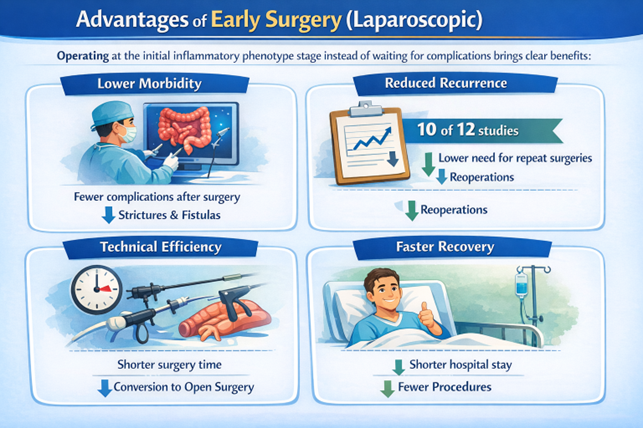
- Patients undergoing early surgery present lower morbidity compared with those treated surgically for complicated disease phenotypes.
- Surgery performed before complications arise results in technically less demanding procedures and fewer reoperations.
- Long-term follow-up demonstrates superior disease control and sustained remission in patients undergoing early resection.
- Early ileocecal resection in pediatric Crohn’s disease may contribute to sustained remission and improved growth outcomes, yet the paucity of evidence highlights the necessity for well-designed prospective trials in this population.
ABSTRACT
Background –
The approval of new therapies has led to an increasing trend toward the use of various combinations of medications in Crohn’s disease (CD) management. However, patients with ileocecal CD may still require surgery in up to 80% of cases. Objectives – To analyze the literature and synthesize the data qualitatively to evaluate the outcomes of early surgery compared to drug therapy in patients with ileocecal CD, focusing on both adult and pediatric populations. Methods – Studies were selected through an electronic search of the PUBMED database, following the PRISMA (Preferred Reporting Items for Systematic Reviews and Meta-Analyses) guidelines. The MINORS (Methodological Index for Non-Randomized Studies) criteria were used to assess the methodological quality of non-randomized studies. Results – A total of 665 articles were initially identified through the search strategy, and three additional relevant articles were added manually, leading to 22 studies eligible for qualitative evaluation. The evaluation of results was organized based on primary outcomes. Three studies assessed postoperative morbidity, with two showing higher morbidity in patients who underwent surgery for CD complications compared to those operated on for a purely inflammatory phenotype. Twelve observational studies evaluated CD recurrence, with ten showing evidence of higher surgical recurrence in patients who underwent surgery at a later stage. These studies demonstrated worse long-term clinical control of CD in this group, with a higher need for corticosteroids and advanced therapies. Only two pediatric studies met the inclusion criteria, limiting a more comprehensive analysis of this population. Conclusion – Early surgery in adult patients is a solid therapeutic option in the treatment of uncomplicated isolated ileocecal CD.
AUTORES
Elvis Paim FERREIRA, Mariana da Silva ARBUÉS, André Castro LYRA and Lourianne Nascimento CAVALCANTE
