
HIGHLIGHTS
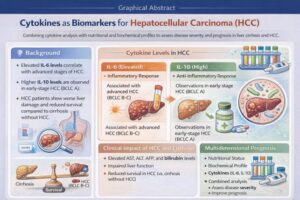
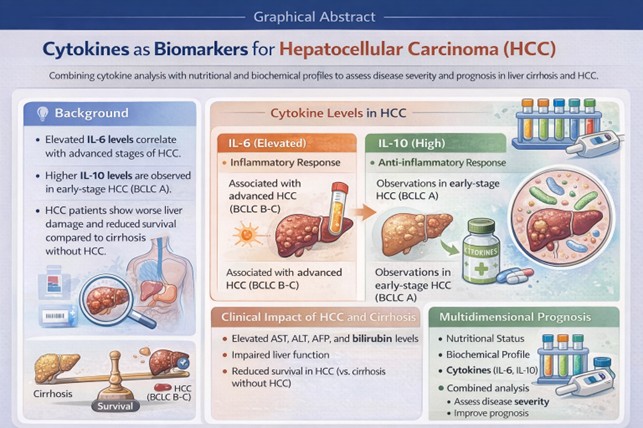
- Elevated IL-6 levels are significantly associated with advanced stages of hepatocellular carcinoma (HCC), suggesting its potential as a progression biomarker.
- Higher IL-10 concentrations are observed in early-stage HCC (BCLC A), indicating an anti-inflammatory response at the onset of tumor development.
- HCC patients present worse liver damage markers (AST, ALT) and reduced survival compared to cirrhotic patients without HCC.
- Nutritional and biochemical profiles combined with cytokine analysis offer a comprehensive approach to assess disease severity and prognosis in liver cirrhosis and HCC.
ABSTRACT
Background –
Hepatocellular carcinoma (HCC) is the leading cause of mortality among cirrhotic patients, often linked to advanced liver disease. Objective – This cross-sectional study evaluated the nutritional factors, cytokine profiles, liver function parameters, and survival of patients with liver cirrhosis (LC) and HCC. Methods – Forty-seven patients were grouped as LC (n=21) or LC with HCC (n=26). Nutritional status was assessed through anthropometry, bioelectrical impedance analysis, and dietary recall, while cytokine levels (IL-6, IL-10, TNF-α) and biochemical markers (AST, ALT, albumin, prealbumin) were analyzed. Survival data were evaluated using Kaplan-Meier curves and Cox regression. Results – HCC patients exhibited higher IL-6 levels, correlating with advanced disease stages (P=0.035). IL-10 levels were elevated in early-stage HCC (BCLC A) compared to BCLC B (P=0.006). AST and ALT levels were significantly higher in HCC patients, reflecting greater hepatocyte damage. Survival analysis revealed a median of 756 days, with shorter survival in HCC patients (P=0.0172). Conclusion – This study highlights the roles of IL-6 and IL-10 as potential biomarkers in HCC progression and provides critical insights into the biochemical and nutritional profiles associated with LC and HCC. These findings may inform future therapeutic interventions.
AUTORES
Iara Carvalho FARIA, Leonardo Trevizan MONICI, Célia Regina PAVAN, Jazon Romilson de Souza ALMEIDA, Sergio Henrique Dias Marques FARIA and Tiago SEVÁ-PEREIRA