

HIGHLIGHTS
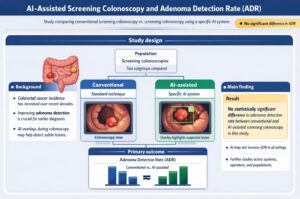
The incidence of colorectal cancer has been increasing in the past decades, leading to the necessity of new approaches to improve adenoma detection rate in order to increase diagnoses. The introduction of artificial intelligence (AI) softwares during colonoscopies might improve detection of early lesions according to previous data. The present study evaluated the adenoma detection rates in patients who underwent screening colonoscopies, divided into two subgroups: one with the conventional technique, and the other using a specific AI system. However, no significant difference was found between these two modalities in the adenoma detection rate.
ABSTRACT
Background/Objective –
Colonoscopy is a known tool for diagnosing precursor lesions of colorectal cancer. The use of AI has the potential to enhance the detection of these lesions. The aim of this study is to compare the adenoma detection rate (ADR) in colonoscopies performed with and without AI software. Methods – An observational study was conducted in the endoscopy department with the contribution of the gastroenterology, coloproctology and pathology services, all from a tertiary hospital in the southern region of Brazil. A total of 305 patients undergoing screening colonoscopy were evaluated. Patients were scheduled for colonoscopy through random assignment to procedure rooms with high definition conventional colonoscopy (CC) or with “Cadeye” (CADe) system. The metrics associated with patients, the procedure and polyps’ features were recorded. Results – Of 305 colonoscopies, 112 were in the CADe system and 193 in the CC. 470 polyps were detected. The overall ADR was 53.8% and the overall polyp detection was 74.8%. There was no difference in the ADR between CC and CADe (57% vs 48.2%, respectively. P=0.138). Conclusions – Although data argue for an increase in ADR with AI systems, our study did not show difference between conventional colonoscopy or AI. These findings suggest that, in settings with high ADR, the added benefit of AI may be limited.
AUTORES
Carolina Roos MARIANO DA ROCHA, Sophia Andreola BORBA, Thales Tomaz RICHINHO, Leonardo Wagner GRILLO, Fernando Comunello SCHACHER, Rafael Castilho PINTO, Fernando Herz WOLFF and Fabio SEGAL.