
HIGHLIGHTS
- Due to the intermediate prevalence of gastric cancer in Brazil, this study aimed to determine the prevalence of gastric cancer and especially its precursor lesions in individuals undergoing routine upper gastrointestinal endoscopies at a tertiary hospital in Brazil.
- This study evaluated diagnostic upper endoscopies in patients older than 40 years old during a year period, using the operative link on gastritis assessment (OLGA) classification by a pathologist specialized in gastrointestinal pathology.
- The studied had found correlations between dysplastic and neoplastic lesions and male sex, age >80 years and the prevalence of chronic atrophic gastritis and intestinal metaplasia, and age 40–49 years and the prevalence of Helicobacter pylori infection.
- The group of patients that were suggested to be at higher risk of dysplastic lesions need further prospective studies to formulate prevention strategies.
ABSTRACT
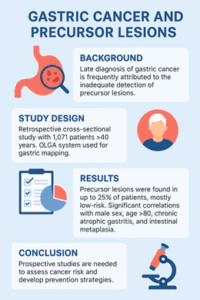
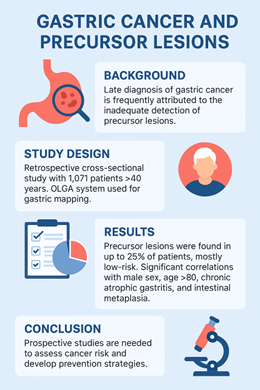
Background – The late diagnosis of gastric cancer, which is usually diagnosed via upper digestive endoscopy, may be attributed to the failure to detect precursor lesions. This study aimed to determine the prevalence of gastric cancer and its precursor lesions in individuals undergoing routine upper gastrointestinal endoscopies at a tertiary hospital in Brazil. Methods – Patients aged >40 years who had undergone diagnostic endoscopic examinations in 2017 at our institution were included in this retrospective cross-sectional study. We exclude patients with more than one examination in the time-period, without gastric biopsies, and those with autoimmune atrophic gastritis and history of gastric surgery. The histopathological findings were reviewed by two gastrointestinal pathologists. The Operative Link on Gastritis Assessment (OLGA) classification was used in cases wherein gastric mapping was performed. Descriptive statistical analysis for the diagnostic findings of the malignant precursor lesions and gastric cancer was performed using Chi-square test. Statistical significance was set at P<0.05. Results – Among the 1,071 patients (64.6% females; age 60±10.4 years old) who underwent endoscopic examinations, 277 (25.9%) were diagnosed with malignant precursor lesions or cancer, three (0.3%) dysplastic lesions, and 12 (1.1%) neoplasms. A total of 888 patients underwent gastric mapping; OLGA III and IV stages were observed in 46 (5.2%) patients. Chi-square test revealed significant correlations between dysplastic and neoplastic lesions and male sex, age >80 years and the prevalence of chronic atrophic gastritis and intestinal metaplasia, and age 40–49 years and the prevalence of Helicobacter pylori infection. Conclusion – Precursor lesions for gastric cancer were observed in up to 25% of the patients, with a predominance of low-risk lesions. Further prospective studies must be conducted to evaluate the risk of gastric cancer in individuals with precursor lesions and formulate prevention strategies.
AUTORES
Victor Cangussu Teixeira CAMPOS, Mayara Pezzini ARANTES, Luiz Roberto KOTZE, Leticia ROSEVICS, Susan Louise Kakitani TAKATA, Renata BRANDALISE, Eduardo Aimoré BONIN and Sandra TEIXEIRA