
HIGHLIGHTS
- The study investigates the relationship between nonalcoholic steatohepatitis (NASH) and rheumatoid arthritis (RA), analyzing the impact of hydroxychloroquine (HCQ) use on the development of NASH.
- HCQ slows the progression of RA; however, its effect on the liver is not yet fully understood.
- This multicenter retrospective cohort study analyzed 619,350 adult patients diagnosed with RA.
- RA patients on HCQ showed an increased prevalence and higher odds of developing NASH. This association should be considered to prevent advanced liver disease
ABSTRACT
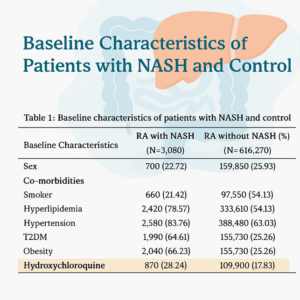
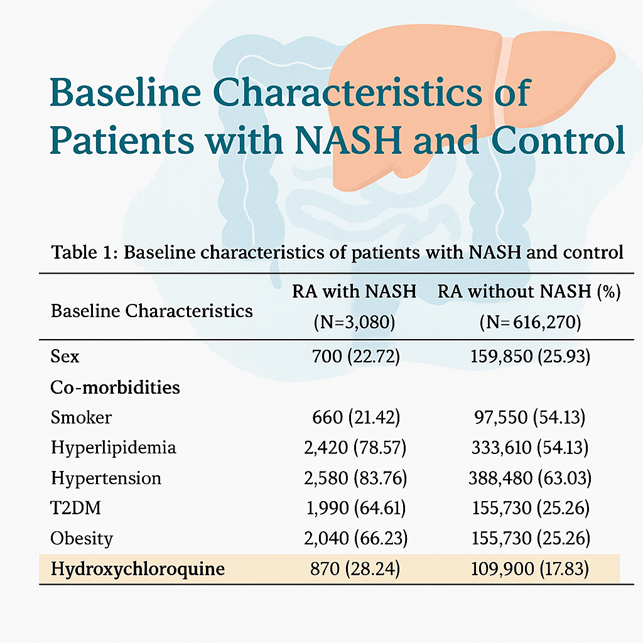
Background – Non-alcoholic steatohepatitis (NASH) is becoming a leading cause of liver disease in the US, while Rheumatoid arthritis (RA) affects a significant portion of the global population. In recent times, newer drugs have been developed to slow down the progression of RA, one of which is hydroxychloroquine (HCQ). Despite HCQ being linked to slowly progressive transaminitis, its role in the development of NASH remains unclear. Our research fills this gap by examining the prevalence and risk factors of developing NASH in patients with RA on HCQ. Methods – This retrospective cohort study analyzed 619,350 adult patients diagnosed with RA. Data were sourced from a multicenter database covering over 360 hospitals across 26 healthcare systems in the US from 1999 to September 2022, excluding pregnant individuals. Multivariate regression analysis assessed the risk of NASH, adjusting for confounders including smoking history, male gender, dyslipidemia, hypertension, type 2 diabetes mellitus, obesity, and hydroxychloroquine use. Statistical significance was set at P<0.05, with analyses conducted using R version 4.0.2 (R Foundation for Statistical Computing, Vienna, Austria, 2008). Results – In a cohort of 79.4 million individuals, 619,350 non-pregnant subjects had rheumatoid arthritis, with 3,080 diagnosed with NASH, while 616,270 did not. Patients with NASH displayed a higher prevalence of smoking history, hyperlipidemia, hypertension, type 2 diabetes mellitus, obesity, and HCQ use. Multivariate regression analysis identified increased NASH risk in smokers (OR: 1.24; 95%CI: 1.14–1.36), males (OR: 0.88; 95%CI: 0.81–0.96), individuals with dyslipidemia (OR: 1.34; 95%CI: 1.21–1.47), hypertension (OR: 1.11; 95%CI: 1.00–1.27), type 2 diabetes mellitus (OR: 3.24; 95%CI: 2.98–3.54), obesity (OR: 3.59; 95%CI: 3.31–3.89), and hydroxychloroquine use (OR: 1.79; 95%CI: 1.65–1.94). Conclusion – RA patients on HCQ showed an increased prevalence and odds of developing NASH, even after adjusting for common confounding factors. This indicates that HCQ may play a role in the development of hepatic steatosis and fibrosis. Clinicians should consider this association to prevent advanced liver disease. Future research should focus on optimal screening for early detection and enhancing patient outcomes. Keywords – Nonalcoholic steatohepatitis; rheumatoid arthritis; hydroxychloroquine.
AUTORES
Antoine BOUSTANY1, Somtochukwu ONWUZO2, Adejoke JOHNSON3, David FARHAT4, Mimi NAJJAR5, Hadi Khaled Abou ZEID6, Chidera N ONWUZO7, Mohamad-Noor ABU-HAMMOUR8, Rashid ABDEL-RAZEQ8, Islam MOHAMED8, Barish EREN8 and Imad ASAAD9